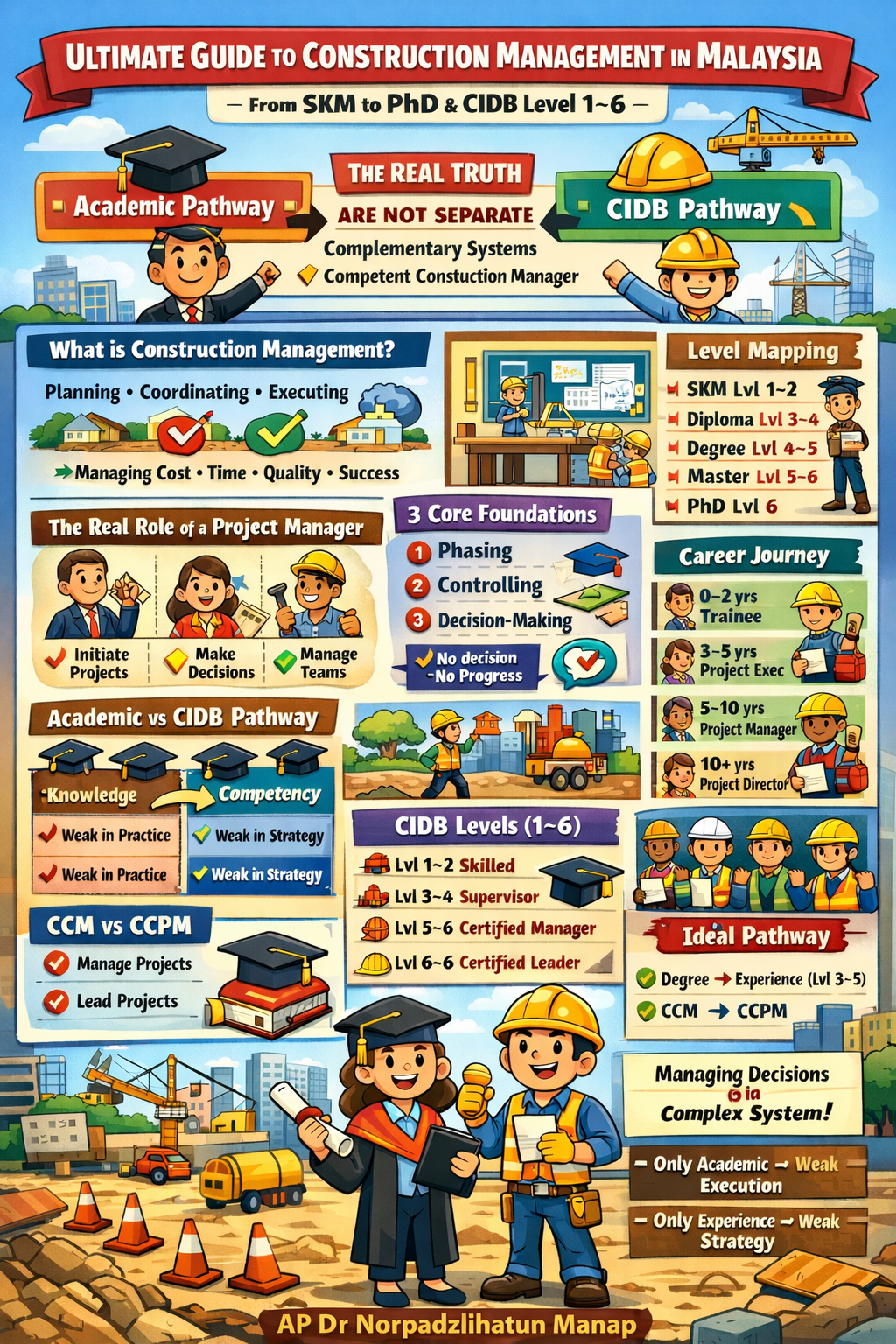
Dalam industri pembinaan Malaysia, terdapat dua laluan utama yang sering bergerak secara berasingan:
- Laluan akademik (SKM, Diploma, Ijazah Sarjana Muda, Master, PhD)
- Laluan profesional melalui CIDB Malaysia (Tahap 1–6)
Namun hakikat sebenar:
Kedua-dua laluan ini bukan berasingan—
ia adalah sistem yang saling melengkapi dalam membentuk seorang Pengurus Pembinaan yang kompeten.
1. Apa Sebenarnya Maksud Pengurusan Pembinaan
Secara asas, Pengurusan Pembinaan sering ditakrifkan sebagai:
Perancangan, penyelarasan, kawalan dan pelaksanaan projek pembinaan dari awal hingga siap.
Namun dalam realiti:
Pengurusan pembinaan adalah keupayaan mengurus sistem yang kompleks—di mana setiap keputusan memberi kesan kepada kos, masa, kualiti dan kejayaan keseluruhan projek.
Sifat sesuatu projek ialah:
- Sementara
- Unik
- Berorientasikan matlamat
Ini bermaksud:
👉 Tiada formula standard
👉 Setiap projek memerlukan keputusan yang berbeza
2. Peranan Sebenar Pengurus Projek Pembinaan
Seorang Pengurus Projek Pembinaan bukan sekadar penyelaras.
Mereka bertanggungjawab untuk:
- Memulakan aktiviti projek
- Merancang dan mengawal pelaksanaan
- Membuat keputusan kritikal
- Mengurus pasukan dan pihak berkepentingan
Projek tidak akan bergerak tanpa keputusan.
3. Tiga Asas Utama Pengurusan Pembinaan
Berdasarkan amalan sebenar industri, terdapat tiga asas utama:
1. Fasa (Phasing)
Memecahkan projek kepada peringkat yang boleh diurus:
- Inception → Reka Bentuk → Tender → Pembinaan → Penyerahan → Operasi
2. Kawalan (Controlling)
Mengurus:
- Masa
- Kos
- Kualiti
- Organisasi
- Maklumat
3. Membuat Keputusan (Decision-Making)
Membuat keputusan yang tepat pada masa yang tepat untuk memastikan projek terus bergerak.
4. Laluan Akademik vs Laluan Profesional CIDB
Laluan Akademik
Memberi:
- Ilmu pengetahuan
- Pemikiran kritikal
- Keupayaan analisis
Laluan CIDB
Memberi:
- Kompetensi
- Pengiktirafan industri
- Keupayaan praktikal
Ilmu tanpa kompetensi = lemah dalam pelaksanaan
Kompetensi tanpa ilmu = terhad dalam strategi
5. Pemetaan Tahap Akademik dan CIDB
| Tahap Akademik | Tahap CIDB | Fokus |
|---|---|---|
| SKM (Sijil Kemahiran Malaysia) | Tahap 1–2 | Kemahiran asas |
| Diploma | Tahap 3–4 | Penyeliaan |
| Ijazah Sarjana Muda | Tahap 4–5 | Pengurusan projek |
| Master | Tahap 5–6 | Strategi & kompleksiti |
| PhD | Tahap 6 | Kepimpinan & pemikiran sistem |
6. Laluan Kerjaya: Dari Graduan ke Pengurus Pembinaan
Peringkat 1 (0–2 tahun): Pendedahan Realiti
Peranan:
- Site Engineer
- Trainee
Fokus:
- Memahami operasi tapak
- Mengenali masalah sebenar
Peringkat 2 (3–5 tahun): Mengurus Tugas
Peranan:
- Project Executive
- Coordinator
Fokus:
- Mengurus sebahagian projek
- Mengaplikasikan teori dalam situasi sebenar
Peringkat 3 (5–10 tahun): Mengurus Projek
Peranan:
- Project Manager
- Construction Manager
Fokus:
- Mengawal keseluruhan projek
- Membuat keputusan operasi
Peringkat 4 (10+ tahun): Kepimpinan Strategik
Peranan:
- Senior Manager
- Project Director
Fokus:
- Membuat keputusan strategik
- Memimpin projek berskala besar
7. Tahap Profesional CIDB (1–6)
Tahap 1–2: Tenaga Kerja Mahir
- Kemahiran asas pembinaan
- Kesedaran keselamatan
Contoh:
- Sijil KemSKKP
- Kad Hijau CIDB
Tahap 3–4: Penyeliaan
- Penyeliaan tapak
- Koordinasi kerja
Contoh:
- Construction Site Supervisor (CSS)
Tahap 5: Certified Construction Manager (CCM)
Fokus:
- Pelaksanaan projek
- Kawalan kos, masa dan kualiti
👉 Tahap pengurusan
Tahap 6: Certified Construction Project Manager (CCPM)
Fokus:
- Keputusan strategik
- Kepimpinan keseluruhan projek
👉 Tahap kepimpinan tertinggi
8. CCM vs CCPM: Perbezaan Sebenar
| Aspek | CCM (Tahap 5) | CCPM (Tahap 6) |
|---|---|---|
| Fokus | Pelaksanaan | Strategi |
| Peranan | Mengurus projek | Memimpin projek |
| Keputusan | Operasi | Kritikal & strategik |
| Skop | Sebahagian | Keseluruhan |
Perbezaan sebenar bukan pada sijil—
tetapi pada tahap pemikiran dan tanggungjawab
9. Realiti Industri Yang Perlu Difahami
Ramai graduan berfikir:
👉 “Cukup ada degree untuk jadi Project Manager”
Tetapi realitinya:
Ijazah memberi pengetahuan—
kompetensi dibina melalui pengalaman dan pensijilan profesional
10. Kenapa Integrasi Ini Penting
Tanpa integrasi:
- Graduan sukar menyesuaikan diri di tapak
- Industri kekurangan pemimpin berkualiti
Dengan integrasi:
- Profesional yang kuat dapat dibentuk
- Industri menjadi lebih kompetitif
11. Laluan Pembangunan Ideal
Laluan realistik:
- Ijazah → masuk industri
- Kumpul pengalaman (Tahap 3–5 CIDB)
- Sambung Master (jika perlu)
- Capai CCM → CCPM
12. Intipati Sebenar Pengurusan Pembinaan
Akhirnya:
Pengurusan pembinaan bukan tentang mengurus tugas—
tetapi tentang mengurus keputusan dalam sistem yang kompleks
Kesimpulan
Perjalanan dari SKM ke PhD, dan dari Tahap 1 hingga Tahap 6 CIDB menunjukkan satu hakikat penting:
Industri pembinaan tidak melahirkan pemimpin secara segera—
ia membentuk mereka secara berperingkat melalui ilmu, pengalaman dan keupayaan membuat keputusan
Mesej Akhir
Mereka yang hanya ada kelayakan akademik akan lemah dalam pelaksanaan
Mereka yang hanya bergantung pada pengalaman akan terhad dalam strategi
Tetapi:
Mereka yang menggabungkan kedua-duanya—
akan menjadi pemimpin sebenar dalam industri pembinaan
Ultimate Guide to Construction Management in Malaysia: From SKM to PhD and CIDB Level 1–6
In Malaysia’s construction industry, two major pathways often exist separately:
- Academic pathway (SKM, Diploma, Degree, Master, PhD)
- Professional pathway via CIDB Malaysia (Level 1–6)
However, the real truth is:
These two pathways are not separate—
they are complementary systems that shape a competent Construction Manager.
1. What Construction Management Really Means
At a basic level, Construction Management is often defined as:
Planning, coordinating, controlling, and executing construction projects from start to completion.
But in reality:
Construction Management is the ability to manage a complex system—where decisions directly affect cost, time, quality, and overall project success.
A project itself is:
- Temporary
- Unique
- Goal-oriented
This means:
👉 There is no standard formula
👉 Every project requires new decisions
2. The Real Role of a Construction Project Manager
A Construction Project Manager is not just a coordinator.
They are responsible to:
- Initiate project activities
- Plan and control execution
- Make critical decisions
- Manage teams and stakeholders
A project does not move forward without decisions.
3. The Three Core Foundations of Construction Management
From real industry practice (and CCPM philosophy), there are three core pillars:
1. Phasing
Breaking projects into manageable stages:
- Inception → Design → Tender → Construction → Handover → Operation
2. Controlling
Managing:
- Time
- Cost
- Quality
- Organization
- Information
3. Decision-Making
Making the right decision at the right time to move the project forward
4. Academic Pathway vs CIDB Professional Pathway
Academic Pathway
Provides:
- Knowledge
- Critical thinking
- Analytical ability
CIDB Pathway
Provides:
- Competency
- Industry recognition
- Practical capability
Academic knowledge without competency = weak in practice
Competency without knowledge = limited in strategy
5. Mapping Academic Levels with CIDB Levels
| Academic Level | CIDB Level | Focus |
|---|---|---|
| SKM | Level 1–2 | Basic skills |
| Diploma | Level 3–4 | Supervision |
| Bachelor’s Degree | Level 4–5 | Project management |
| Master’s Degree | Level 5–6 | Strategy & complexity |
| PhD | Level 6 | Leadership & system thinking |
6. Career Journey: From Graduate to Construction Manager
Stage 1 (0–2 years): Reality Exposure
Roles:
- Site Engineer
- Trainee
Focus:
- Understanding site operations
- Learning real-world problems
Stage 2 (3–5 years): Managing Tasks
Roles:
- Project Executive
- Coordinator
Focus:
- Managing parts of a project
- Applying theory into practice
Stage 3 (5–10 years): Managing Projects
Roles:
- Project Manager
- Construction Manager
Focus:
- Controlling the full project
- Making operational decisions
Stage 4 (10+ years): Strategic Leadership
Roles:
- Senior Manager
- Project Director
Focus:
- Strategic decision-making
- Leading large-scale projects
7. CIDB Professional Levels (1–6)
Level 1–2: Skilled Workforce
- Basic construction skills
- Safety awareness
Examples:
- SKKP
- CIDB Green Card
Level 3–4: Supervisory Level
- Site supervision
- Work coordination
Examples:
- Construction Site Supervisor (CSS)
Level 5: Certified Construction Manager (CCM)
Focus:
- Project execution
- Managing cost, time, and quality
👉 This is management level
Level 6: Certified Construction Project Manager (CCPM)
Focus:
- Strategic decision-making
- Full project leadership
👉 This is leadership level
8. CCM vs CCPM: The Real Difference
| Aspect | CCM (Level 5) | CCPM (Level 6) |
|---|---|---|
| Focus | Execution | Strategy |
| Role | Manage project | Lead project |
| Decision | Operational | Critical & strategic |
| Scope | Partial | Entire project |
The difference is not the certificate—
it is the level of thinking and responsibility
9. A Critical Industry Reality
Many graduates believe:
👉 “A degree is enough to become a Project Manager”
But in reality:
A degree gives knowledge—
competency is built through experience and professional certification
10. Why Integration Matters
Without integration:
- Graduates struggle in real projects
- Industry lacks capable leaders
With integration:
- Strong professionals are produced
- Industry becomes more competitive
11. The Ideal Development Path
A realistic pathway:
Degree → Enter industry
Gain experience (Level 3–5 CIDB)
Pursue Master (if needed)
Achieve CCM → CCPM
12. Final Insight: What Construction Management Truly Is
Ultimately:
Construction Management is not about managing tasks—
it is about managing decisions within a complex system.
Conclusion
The journey from SKM to PhD, and from CIDB Level 1 to Level 6, shows one critical truth:
The construction industry does not produce leaders instantly—
it develops them progressively through knowledge, experience, and decision-making capability.
Final Message
Those who only have academic qualifications will struggle in execution.
Those who only rely on experience will struggle in strategy.
But:
Those who integrate both—
will become true leaders in the construction industry.