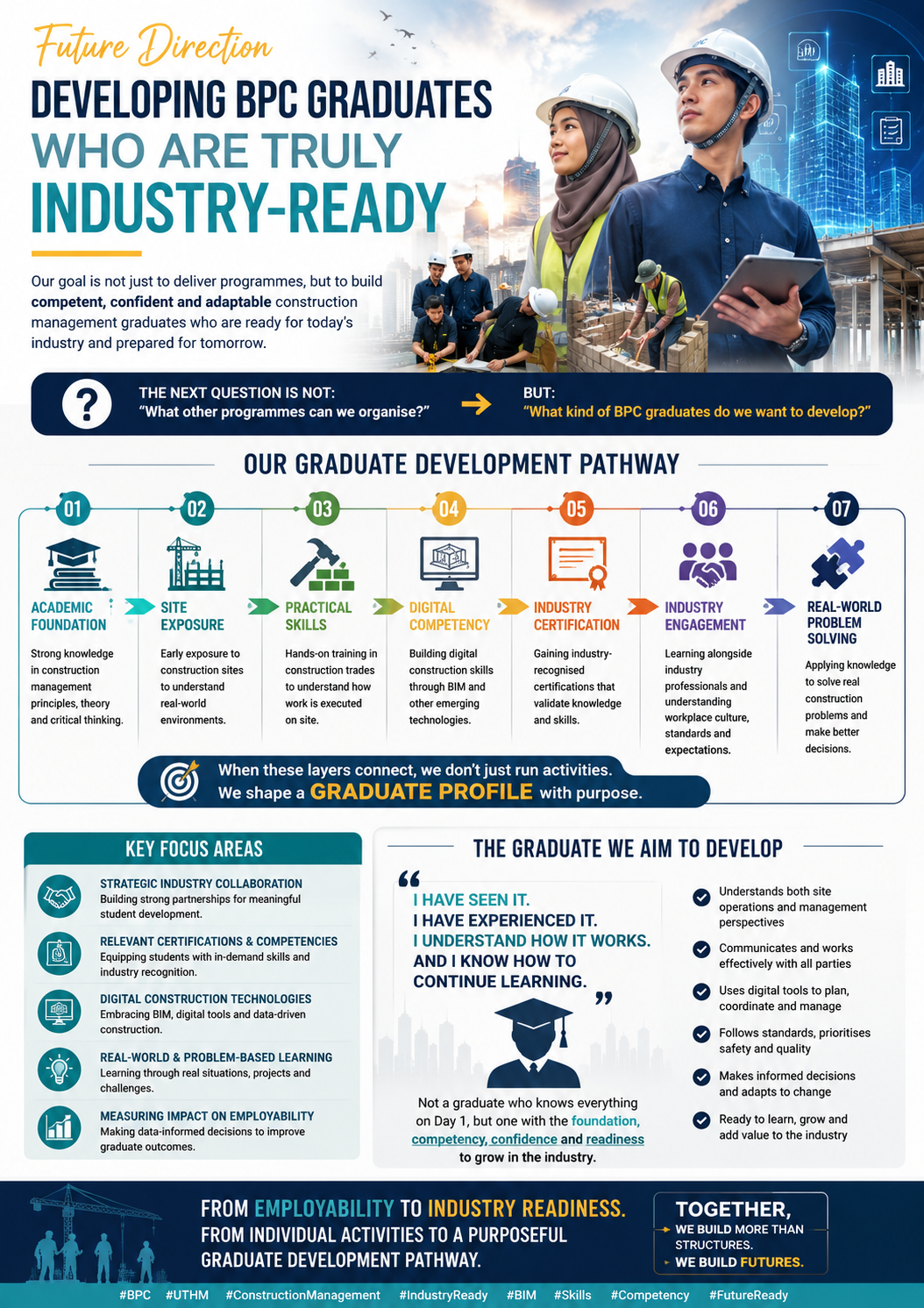
Selepas melihat sendiri perkembangan pelajar melalui latihan kemahiran, pensijilan, pendedahan industri dan BIM, saya semakin yakin bahawa persoalan seterusnya bukan lagi:
“Program apa lagi yang boleh kita anjurkan?”
Tetapi:
“Apakah profil graduan BPC yang kita mahu lahirkan?”
Bagi saya, graduan Pengurusan Teknologi Pembinaan masa hadapan perlu mempunyai lebih daripada pengetahuan akademik.
Mereka perlu mampu memahami apa yang berlaku di tapak, berkomunikasi dengan tenaga kerja, menggunakan teknologi digital, memahami standard industri, membuat keputusan berdasarkan situasi sebenar dan menyesuaikan diri dengan perubahan industri pembinaan.
Sebab itu, arah pembangunan seterusnya perlu lebih tersusun.
Bukan sekadar menghimpunkan kursus dan sijil, tetapi membina satu laluan pembangunan graduan daripada tahun awal pengajian sehingga mereka bersedia memasuki alam pekerjaan.
Saya membayangkan perjalanan itu merangkumi beberapa lapisan:
Asas akademik → pendedahan tapak → kemahiran praktikal → kompetensi digital → pensijilan industri → interaksi dengan pemain industri → pengalaman penyelesaian masalah sebenar
Setiap lapisan memberi nilai yang berbeza.
Latihan kemahiran membantu pelajar memahami realiti kerja.
BIM membantu mereka memahami bagaimana industri bergerak ke arah pembinaan digital.
Pensijilan memberi pengiktirafan terhadap kompetensi.
Pendedahan bersama pekerja industri pula membantu mereka memahami budaya kerja, disiplin, keselamatan dan standard yang sebenar.
Apabila semua ini disusun dengan baik, kita tidak lagi melihatnya sebagai aktiviti berasingan.
Kita mula melihat profil graduan yang sedang dibentuk.
Ke hadapan, saya berharap lebih banyak ruang dapat dibuka untuk pelajar melalui:
- kerjasama industri yang lebih strategik;
- pensijilan dan kompetensi yang relevan dengan keperluan pekerjaan;
- penggunaan teknologi pembinaan digital;
- pembelajaran berasaskan situasi dan masalah sebenar industri;
- serta pengukuran impak program terhadap kebolehpasaran graduan.
Pada akhirnya, sasaran saya bukan untuk memastikan pelajar mempunyai sebanyak mungkin sijil.
Sijil hanyalah salah satu bukti.
Yang lebih penting ialah apabila mereka memasuki industri nanti, mereka boleh berkata:
“Saya pernah melihatnya. Saya pernah mencubanya. Saya faham bagaimana ia dilaksanakan. Dan saya tahu bagaimana untuk terus belajar.”
Itulah graduan yang saya mahu lihat.
Bukan graduan yang mengetahui segala-galanya pada hari pertama bekerja, tetapi graduan yang mempunyai asas, kompetensi, keyakinan dan kesediaan untuk berkembang dalam industri.
Itulah arah seterusnya untuk BPC.
Daripada kebolehpasaran kepada kesiapsiagaan industri.
Daripada aktiviti kepada satu laluan pembangunan graduan yang mempunyai tujuan.
#BPC #UTHM #PengurusanTeknologiPembinaan #KesiapsiagaanIndustri #KebolehpasaranGraduan #BIM #PembinaanDigital #KompetensiProfesional #TVET #IndustriAkademia #PembangunanGraduan
Future Direction: Developing BPC Graduates Who Are Truly Industry-Ready
After seeing students progress through skills training, certification, industry exposure, and BIM, I have become increasingly convinced that the next question should no longer be:
“What other programmes can we organise?”
Instead, the more important question is:
“What kind of BPC graduates do we want to develop?”
For me, future Construction Management graduates need more than academic knowledge.
They need to understand what happens on site, communicate effectively with the workforce, use digital technologies, understand industry standards, make decisions based on real situations, and adapt to the changing construction industry.
That is why the next stage of graduate development needs to be more structured.
Not simply by accumulating courses and certificates, but by creating a clear graduate development pathway from the early years of study until students are ready to enter the workforce.
I envision this journey as a combination of several layers:
Academic foundation → site exposure → practical skills → digital competency → industry certification → engagement with industry professionals → real-world problem-solving experience
Each layer contributes something different.
Practical skills training helps students understand the realities of construction work.
BIM helps them understand how the industry is moving towards digital construction.
Certification provides formal recognition of competency.
Exposure alongside industry workers helps students understand workplace culture, discipline, safety, and actual industry standards.
When these elements are connected strategically, we no longer see them as separate activities.
We begin to see the graduate profile that is being developed.
Moving forward, I hope to create more opportunities for students through:
- more strategic industry collaboration;
- certifications and competencies that are relevant to employment needs;
- greater exposure to digital construction technologies;
- learning based on real industry situations and problems; and
- systematic evaluation of how these initiatives contribute to graduate employability.
Ultimately, my goal is not to ensure that students collect as many certificates as possible.
A certificate is only one form of evidence.
What matters more is that when they eventually enter the industry, they are able to say:
“I have seen it. I have experienced it. I understand how it works. And I know how to continue learning.”
That is the kind of graduate I hope to see.
Not a graduate who knows everything on the first day of work, but one who possesses the foundation, competency, confidence, and readiness to continue growing within the industry.
That is the next direction for BPC.
From employability to industry readiness.
From individual activities to a purposeful graduate development pathway.
#BPC #UTHM #ConstructionTechnologyManagement #IndustryReadiness #GraduateEmployability #BIM #DigitalConstruction #ProfessionalCompetency #TVET #IndustryAcademia #GraduateDevelopment