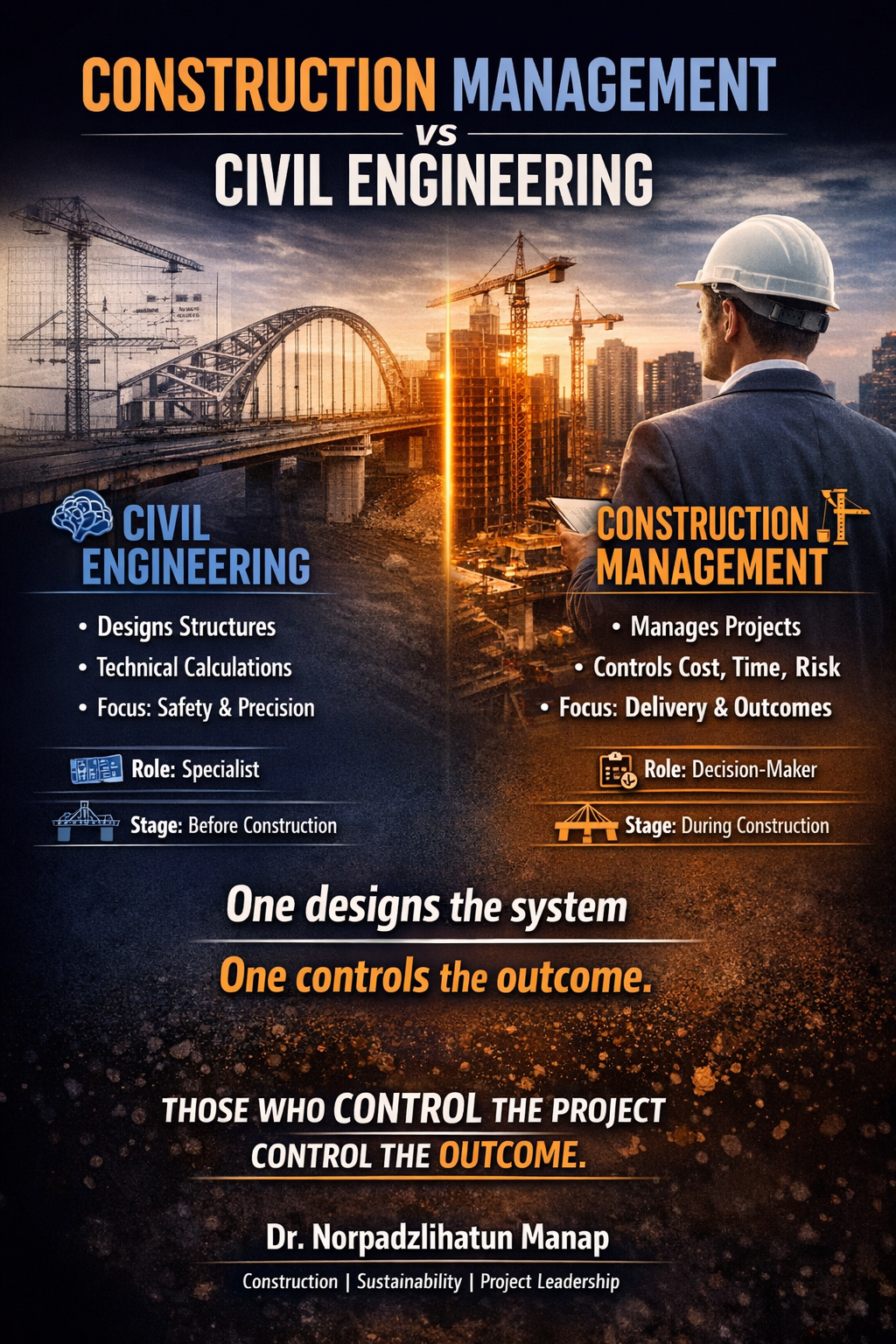
Dua laluan, dua jenis kuasa dalam industri pembinaan
🧭 Gambaran Besar
tetapi memainkan peranan yang sangat berbeza:
- Kejuruteraan Awam → Mereka bentuk dan memastikan struktur selamat
- Pengurusan Pembinaan → Memastikan projek itu benar-benar berlaku dan berjaya
👉 Satu mencipta asas teknikal
👉 Satu lagi menentukan hasil akhir
⚙️ Perbezaan Teras
1. 🧠 Fokus Utama
Kejuruteraan Awam
- Reka bentuk struktur (jalan, jambatan, bangunan)
- Analisis teknikal (beban, tekanan, bahan)
- Pengiraan dan pemodelan
Pengurusan Pembinaan
- Perancangan projek
- Kawalan kos dan masa
- Pengurusan kontrak dan risiko
- Penyelarasan semua pihak
👉 Jurutera bertanya: “Adakah struktur ini selamat?”
👉 Pengurus bertanya: “Boleh siap tepat masa, kos dan kualiti?”
2. 📍 Posisi dalam Projek
Kejuruteraan Awam
- Banyak di peringkat reka bentuk & analisis awal
- Terlibat sebelum pembinaan bermula
Pengurusan Pembinaan
- Dominan di peringkat pelaksanaan projek (construction stage)
- Terlibat dari awal hingga siap projek
👉 Jurutera mencipta pelan
👉 Pengurus memastikan pelan itu menjadi realiti
3. 🧩 Jenis Kemahiran
Kejuruteraan Awam
- Matematik dan fizik yang kuat
- Analisis teknikal mendalam
- Ketepatan pengiraan
Pengurusan Pembinaan
- Kepimpinan dan komunikasi
- Pengurusan konflik
- Keputusan pantas dalam situasi sebenar
👉 Satu fokus pada ketepatan teknikal
👉 Satu fokus pada keputusan dalam kompleksiti
4. 📊 Risiko & Tanggungjawab
Kejuruteraan Awam
- Risiko kegagalan struktur
- Keselamatan awam
- Tanggungjawab profesional (design liability)
Pengurusan Pembinaan
- Risiko kewangan projek
- Kelewatan (delay)
- Pertikaian kontrak
👉 Jurutera menanggung risiko teknikal
👉 Pengurus menanggung risiko strategik & kewangan
5. 🚀 Laluan Kerjaya & Kuasa
Kejuruteraan Awam
- Jurutera reka bentuk
- Perunding (consultant)
- Pakar teknikal
Pengurusan Pembinaan
- Pengurus projek
- Pengarah projek
- Pemimpin organisasi pembinaan
👉 Dalam jangka panjang:
- Jurutera = pakar (specialist)
- Pengurus = pembuat keputusan (decision-maker)
🔥 Realiti Industri (Yang Jarang Diceritakan)
Ramai bermula sebagai jurutera.
Tetapi untuk naik ke tahap tertinggi dalam industri:
👉 Mereka perlu beralih kepada pengurusan pembinaan
Kerana:
- Projek tidak gagal kerana pengiraan semata-mata
- Projek gagal kerana pengurusan yang lemah
🇲🇾 Dalam Konteks Malaysia
Dalam pasaran tempatan:
- Graduan kejuruteraan awam → ramai
- Individu yang benar-benar boleh mengurus projek besar → sangat terhad
👉 Ini mewujudkan kelebihan strategik kepada mereka dalam bidang Pengurusan Pembinaan
🎯 Jadi, Mana Lebih Baik?
Soalan ini sebenarnya salah.
Soalan yang betul ialah:
Anda mahu jadi siapa dalam projek?
- Mahu menjadi orang yang mereka bentuk sistem → pilih Kejuruteraan Awam
- Mahu menjadi orang yang mengawal sistem dan hasil akhir → pilih Pengurusan Pembinaan
✍️ Kesimpulan
Dalam struktur kuasa industri pembinaan:
- Kejuruteraan Awam membina asas kepercayaan teknikal
- Pengurusan Pembinaan menentukan kejayaan sebenar projek
Dan pada akhirnya—
Yang mengawal projek, mengawal hasil.
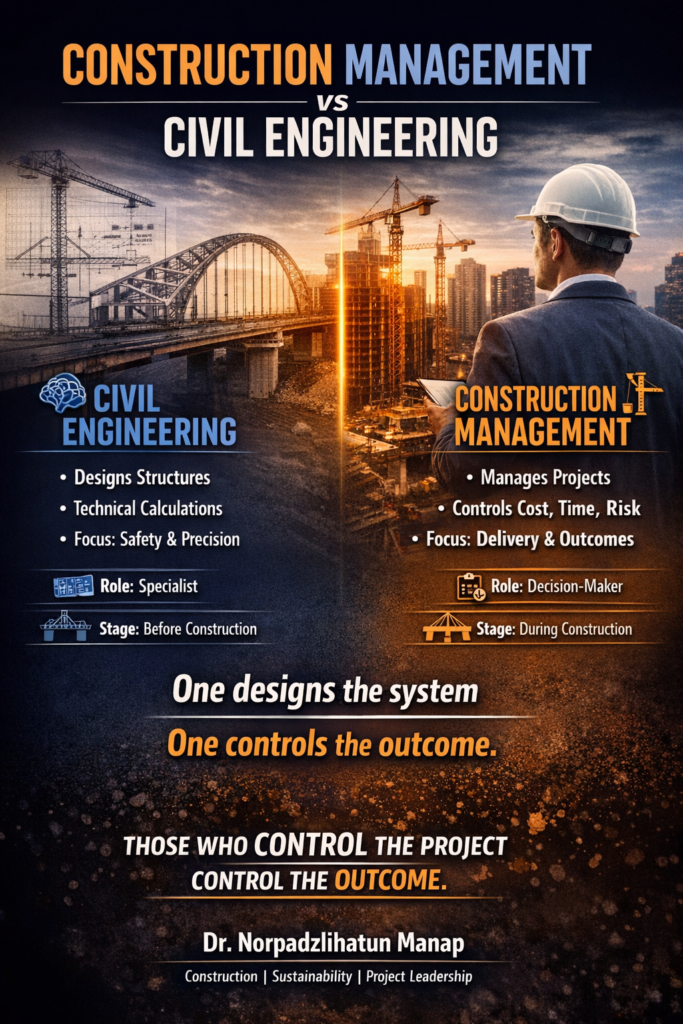
🏗️ Construction Management vs Civil Engineering
Two paths, two types of power in the construction industry
🧭 Big Picture
Both fields operate within the same ecosystem—
but they play fundamentally different roles:
- Civil Engineering → Designs and ensures structural safety
- Construction Management → Ensures the project actually happens—and succeeds
👉 One creates the technical foundation
👉 The other determines the final outcome
⚙️ Core Differences
1. 🧠 Core Focus
Civil Engineering
- Structural design (roads, bridges, buildings)
- Technical analysis (loads, stresses, materials)
- Calculations and modelling
Construction Management
- Project planning
- Cost and time control
- Contract and risk management
- Coordination of all stakeholders
👉 Engineers ask: “Is this structure safe?”
👉 Managers ask: “Can this be delivered on time, within budget, and at the right quality?”
2. 📍 Position in the Project Lifecycle
Civil Engineering
- Dominant in the design and early analysis stage
- Heavily involved before construction begins
Construction Management
- Dominant in the execution phase (construction stage)
- Involved from initiation to project completion
👉 Engineers create the plan
👉 Managers make the plan a reality
3. 🧩 Skill Sets
Civil Engineering
- Strong mathematics and physics
- Deep technical analysis
- Precision in calculations
Construction Management
- Leadership and communication
- Conflict management
- Fast decision-making in real-world situations
👉 One focuses on technical precision
👉 The other on decision-making under complexity
4. 📊 Risk & Responsibility
Civil Engineering
- Risk of structural failure
- Public safety
- Professional liability (design responsibility)
Construction Management
- Financial risks
- Project delays
- Contract disputes
👉 Engineers carry technical risk
👉 Managers carry strategic and financial risk
5. 🚀 Career Path & Power
Civil Engineering
- Design engineer
- Consultant
- Technical specialist
Construction Management
- Project manager
- Project director
- Organizational leader
👉 In the long run:
- Engineers = specialists
- Managers = decision-makers
🔥 Industry Reality (Rarely Discussed)
Many professionals start as engineers.
But to reach the highest levels in the industry:
👉 They transition into Construction Management
Because:
- Projects rarely fail due to calculations alone
- Projects fail due to poor management
🇲🇾 Malaysian Context
In the local market:
- Civil engineering graduates → abundant
- Individuals who can truly manage large-scale projects → limited
👉 This creates a strategic advantage for those in Construction Management
🎯 So, Which Is Better?
This is the wrong question.
The real question is:
Who do you want to be in a project?
- Want to design the system → choose Civil Engineering
- Want to control the system and outcomes → choose Construction Management
✍️ Conclusion
Within the power structure of the construction industry:
- Civil Engineering builds the technical foundation of trust
- Construction Management determines the actual success of the project
And ultimately—
Those who control the project, control the outcome.