Introduction
Many researchers believe their papers are rejected because of “bad luck” or “harsh reviewers.”
In reality, most rejections happen due to fundamental weaknesses in research design and writing.
Understanding these reasons is the first step toward publishing in Q1/Q2 journals.
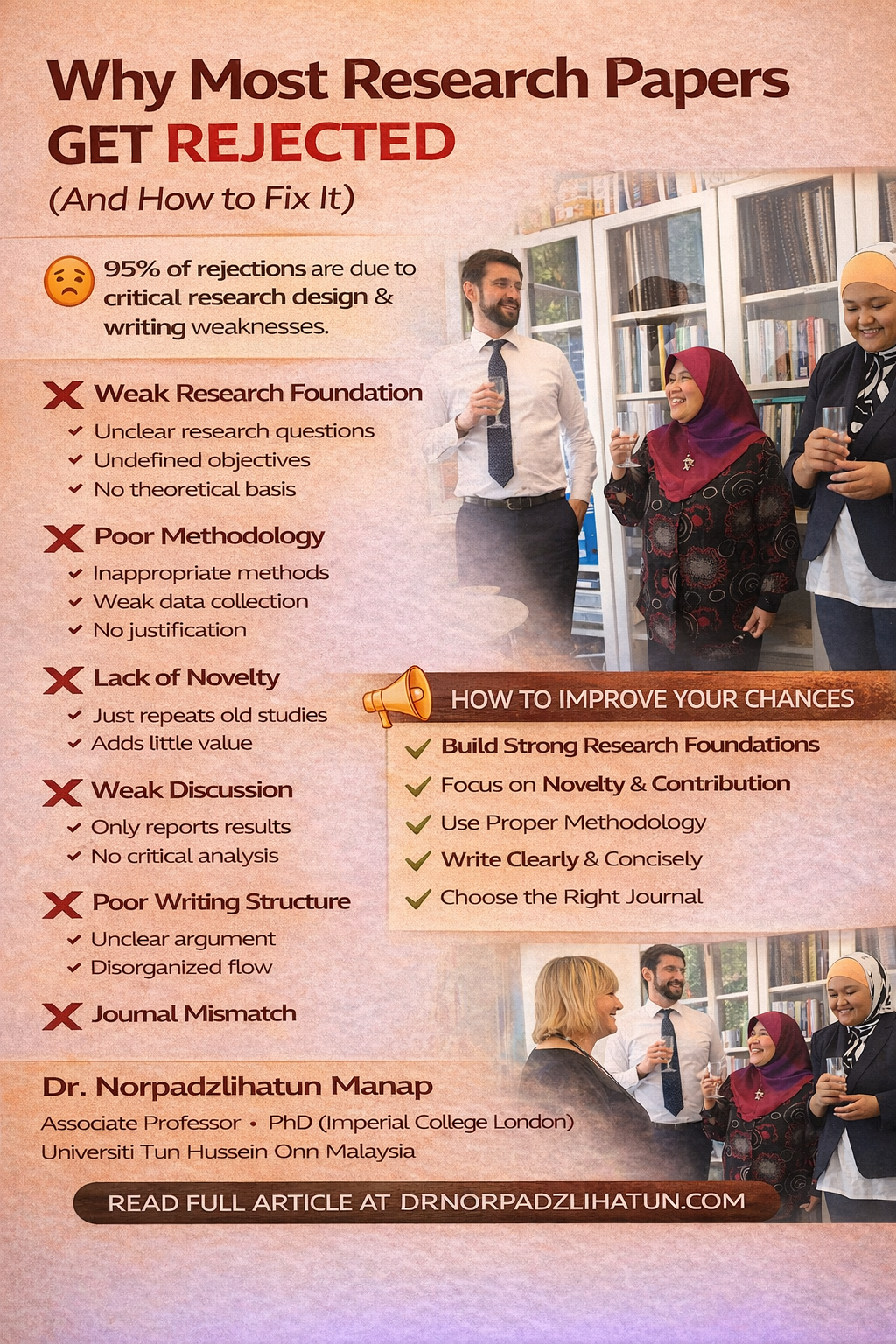
❌ 1. Weak Research Foundation
Many papers fail because:
- Research questions are unclear
- Objectives are not well defined
- No strong theoretical grounding
👉 Journals look for clarity and purpose, not just data.
❌ 2. Poor Methodology
A common issue:
- Inappropriate methods
- Weak data collection
- Lack of justification
👉 Even a “good idea” fails without rigorous methodology.
❌ 3. Lack of Novelty
Reviewers often ask:
“What is new here?”
If your paper:
- Repeats existing studies
- Adds little value
➡️ It will likely be rejected.
❌ 4. Weak Discussion & Analysis
Many papers only:
- Present results
- But fail to explain “why it matters”
👉 High-impact journals expect:
- Critical analysis
- Strong linkage to theory
❌ 5. Poor Writing Structure
Common problems:
- Unclear flow
- Weak argument
- Language issues
👉 A good study can still be rejected due to poor presentation.
❌ 6. Journal Mismatch
Many authors submit to the wrong journal:
- Scope mismatch
- Audience mismatch
👉 Always check:
✔ Journal aims & scope
✔ Recent published papers
🚀 How to Improve Your Chances
✔ Build strong research fundamentals
✔ Focus on novelty and contribution
✔ Use proper methodology
✔ Write clearly and professionally
✔ Choose the right journal
✨ Conclusion
Publishing is not about luck.
It is about quality, clarity, and consistency.
Substance will always outlast noise.
📝
Kenapa Banyak Paper Ditolak (Dan Cara Betulkan)
Pengenalan
Ramai penyelidik menyangka paper ditolak kerana “nasib” atau reviewer terlalu ketat.
Hakikatnya, kebanyakan penolakan berlaku kerana asas penyelidikan yang lemah.
❌ 1. Asas Kajian Lemah
- Soalan kajian tidak jelas
- Objektif kabur
- Tiada teori kukuh
❌ 2. Metodologi Lemah
- Kaedah tidak sesuai
- Data tidak kuat
- Tiada justifikasi
❌ 3. Tiada Kebaharuan
Kajian hanya ulang:
➡️ Tiada nilai tambah
❌ 4. Perbincangan Lemah
- Hanya lapor hasil
- Tiada analisis mendalam
❌ 5. Penulisan Lemah
- Struktur tidak jelas
- Idea tidak tersusun
❌ 6. Salah Pilih Jurnal
- Scope tak sesuai
- Audience tak kena
🚀 Cara Tingkatkan Peluang
✔ Kukuhkan asas kajian
✔ Fokus novelty
✔ Guna metodologi betul
✔ Tulis dengan jelas
✔ Pilih jurnal tepat
✨ Kesimpulan
Bukan nasib—tetapi kualiti dan konsistensi.
Yang berkualiti dan konsisten akan kekal, manakala si kaki bising serta tin kosong akan hilang