News & Event

Construction Management is the New Elite TVET


It is time we stop underestimating the path that actually builds nations


🌍 An Outdated Narrative We Must Abandon

For years, Technical and Vocational Education and Training (TVET) has been labelled as a “second-tier” pathway.
Less prestigious. Less intellectual. Less desirable.

This narrative is not just outdated—
it is dangerous.

Because in the real world, nations are not built by theory alone.
They are built by individuals who can make decisions under pressure, on real sites, with multi-million consequences.

And this is where we fail to recognise a critical truth:

👉 Construction Management is not ordinary TVET.
It represents TVET at its highest level.


🧠 The Reality of Today’s Industry

The construction industry is no longer just about “building structures”.

It is about:

  • Managing high-value projects with tight risk margins
  • Coordinating multiple stakeholders with competing interests
  • Making rapid decisions with long-term consequences
  • Balancing cost, time, quality, and sustainability

This is not routine work.
This is a strategic decision-making arena.

Yet ironically—
we still label this field as “less academic”.


⚙️ Construction Management: At the Intersection of Power

Construction managers operate at the most critical point in the entire system:

  • Not just engineers
  • Not just managers
  • Not just executors

👉 They are the bridge between design and reality
👉 They determine whether a project succeeds—or fails

In many cases, a single decision on-site can:

  • Save millions
  • Or result in massive losses

This is not an ordinary skillset.
This is decision-making power grounded in experience, knowledge, and professional judgement.


🔥 Why This is “Elite TVET”

Because it demands something rare:

1. The Ability to Act Under Uncertainty

Not every problem exists in textbooks.
On-site decisions must be made even with incomplete information.


2. Integration of Knowledge and Execution

Knowing is not enough.
Executing without failure—that is real value.


3. Professional Courage

Every decision carries risk.
But avoiding decisions is also a risk.


4. Large-Scale Responsibility

Construction managers do not handle small tasks.
They manage complex systems that impact the economy, society, and environment.


🇲🇾 Malaysia: The Gap We Do Not Acknowledge

We produce many graduates.

Yet the industry continues to ask:

“Who can actually lead projects?”

The problem is clear:

  • Too many are strong in theory, weak in application
  • Too few can make decisions in real-world conditions

👉 Construction Management directly fills this gap
👉 But only if we stop treating it as a second option


🚀 This is Not an Alternative Path—It is the Dominant One

If you understand the power structure of the construction industry, you will realise:

👉 Those who control projects, control outcomes
👉 Those who make decisions, shape the future

And this field trains you to be in that position.


🎯 Who is This For?

This field is not for everyone.

It is for those who:

  • Are uncomfortable staying in theoretical comfort zones
  • Are willing to carry significant responsibility
  • Want to operate at the frontline of decision-making

👉 If you only want to “pass”, this is not your field
👉 If you want to “lead”, this is your path


✍️ Closing: A Reality We Must Accept

We can continue debating the status of TVET.

Or we can accept this:

The true value of education is not its label—
but its impact in the real world.

And in the real world—

Construction Management is not merely part of TVET.
It is the highest manifestation of what TVET is meant to be: functional, impactful, and powerful.


📩 Professional Positioning

As a researcher in sustainable construction, one reality is becoming increasingly clear:

👉 The industry does not need more conventional graduates
👉 The industry needs technical leaders who can make decisions in real complexity

If you are choosing your academic path:

Do not choose based on perception.
Choose based on where real power lies.


🏗️ Pengurusan Pembinaan ialah TVET Elit Baharu

Sudah tiba masanya kita berhenti memandang rendah laluan yang sebenarnya membina negara

🌍 Naratif Lama yang Perlu Dihentikan

Selama bertahun-tahun, Technical and Vocational Education and Training (TVET) dilabel sebagai laluan “kedua”.
Kurang glamor. Kurang prestij. Kurang intelektual.

Naratif ini bukan sahaja ketinggalan zaman—
ia merbahaya.

Kerana dalam dunia sebenar, negara tidak dibina oleh teori semata-mata.
Ia dibina oleh mereka yang mampu membuat keputusan di bawah tekanan, di tapak sebenar, dengan implikasi jutaan ringgit.

Dan di sinilah kita gagal memahami sesuatu yang kritikal:

👉 Pengurusan Pembinaan bukan TVET biasa.
Ia adalah TVET pada tahap tertinggi.


🧠 Realiti Industri yang Ramai Tidak Faham

Industri pembinaan hari ini bukan lagi tentang “membina struktur”.

Ia tentang:

  • Mengurus projek bernilai tinggi dengan margin risiko yang tipis
  • Menyelaraskan puluhan pihak dengan kepentingan berbeza
  • Membuat keputusan pantas yang memberi kesan jangka panjang
  • Mengimbangi kos, masa, kualiti dan kelestarian

Ini bukan kerja rutin.
Ini adalah arena keputusan strategik.

Namun ironinya—
kita masih melabel bidang ini sebagai “kurang akademik”.


⚙️ Pengurusan Pembinaan: Di Persimpangan Kuasa

Pengurus pembinaan berada di titik paling kritikal dalam keseluruhan sistem:

  • Bukan sekadar jurutera
  • Bukan sekadar pengurus
  • Bukan sekadar pelaksana

👉 Mereka adalah penghubung antara reka bentuk dan realiti
👉 Mereka menentukan sama ada projek berjaya—atau gagal

Dalam banyak kes, satu keputusan di tapak boleh:

  • Menjimatkan jutaan ringgit
  • Atau menyebabkan kerugian besar

Ini bukan kemahiran biasa.
Ini adalah kuasa membuat keputusan berasaskan pengalaman, ilmu dan intuisi profesional.


🔥 Mengapa Ini “TVET Elit”?

Kerana ia menuntut sesuatu yang jarang dimiliki oleh kebanyakan graduan:

1. Keupayaan Bertindak dalam Ketidakpastian

Bukan semua masalah ada dalam buku teks.
Di tapak bina, keputusan perlu dibuat walaupun maklumat tidak lengkap.


2. Integrasi Pengetahuan dan Tindakan

Mengetahui tidak mencukupi.
Melaksanakan tanpa kesilapan—itulah nilai sebenar.


3. Keberanian Profesional

Setiap keputusan ada risiko.
Tetapi tiada keputusan juga adalah satu risiko.


4. Tanggungjawab Berskala Besar

Pengurus pembinaan tidak mengurus tugasan kecil.
Mereka mengurus sistem kompleks yang memberi kesan kepada ekonomi, masyarakat dan alam sekitar.


🇲🇾 Malaysia: Jurang yang Kita Tidak Akui

Kita menghasilkan ramai graduan.

Tetapi industri masih bertanya:

“Siapa yang benar-benar boleh memimpin projek?”

Masalahnya jelas:

  • Terlalu ramai yang kuat teori, lemah aplikasi
  • Terlalu sedikit yang mampu membuat keputusan di lapangan sebenar

👉 Pengurusan Pembinaan adalah jawapan kepada jurang ini
👉 Tetapi hanya jika kita berhenti melihatnya sebagai pilihan kedua


🚀 Ini Bukan Laluan Alternatif—Ini Laluan Dominan

Jika anda memahami struktur kuasa dalam industri pembinaan, anda akan sedar:

👉 Mereka yang mengawal projek, mengawal hasil
👉 Mereka yang membuat keputusan, menentukan masa depan projek

Dan bidang ini melatih anda untuk berada di posisi tersebut.


🎯 Untuk Siapa Bidang Ini?

Bidang ini bukan untuk semua orang.

Ia untuk mereka yang:

  • Tidak selesa dengan zon selamat teori
  • Bersedia memikul tanggungjawab besar
  • Mahu berada di barisan hadapan keputusan

👉 Jika anda hanya mahu “lulus”, ini bukan bidang anda
👉 Jika anda mahu “memimpin”, ini adalah laluan anda


✍️ Penutup: Realiti yang Perlu Diterima

Kita boleh terus berdebat tentang status TVET.

Atau kita boleh menerima hakikat ini:

Nilai sebenar pendidikan bukan pada labelnya—
tetapi pada impaknya dalam dunia sebenar.

Dan dalam dunia sebenar—

Pengurusan Pembinaan bukan sekadar sebahagian daripada TVET.
Ia adalah manifestasi tertinggi TVET yang sebenar: berfungsi, berimpak, dan berkuasa.


📩 Kenyataan Profesional

Sebagai seorang penyelidik dalam bidang pembinaan lestari dan pengurusan projek, saya melihat satu keperluan yang semakin mendesak:

👉 Industri tidak lagi memerlukan lebih ramai graduan biasa
👉 Industri memerlukan pemimpin teknikal yang mampu membuat keputusan dalam kompleksiti sebenar

Jika anda sedang memilih laluan pendidikan:

Jangan pilih berdasarkan persepsi masyarakat.
Pilih berdasarkan di mana kuasa sebenar berada.


Pengurusan Pembinaan vs Kejuruteraan Awam

Dua laluan, dua jenis kuasa dalam industri pembinaan


🧭 Gambaran Besar

Kedua-dua bidang ini berada dalam ekosistem yang sama—

tetapi memainkan peranan yang sangat berbeza:

  • Kejuruteraan Awam → Mereka bentuk dan memastikan struktur selamat
  • Pengurusan Pembinaan → Memastikan projek itu benar-benar berlaku dan berjaya

👉 Satu mencipta asas teknikal
👉 Satu lagi menentukan hasil akhir


⚙️ Perbezaan Teras

1. 🧠 Fokus Utama

Kejuruteraan Awam

  • Reka bentuk struktur (jalan, jambatan, bangunan)
  • Analisis teknikal (beban, tekanan, bahan)
  • Pengiraan dan pemodelan

Pengurusan Pembinaan

  • Perancangan projek
  • Kawalan kos dan masa
  • Pengurusan kontrak dan risiko
  • Penyelarasan semua pihak

👉 Jurutera bertanya: “Adakah struktur ini selamat?”
👉 Pengurus bertanya: “Boleh siap tepat masa, kos dan kualiti?”


2. 📍 Posisi dalam Projek

Kejuruteraan Awam

  • Banyak di peringkat reka bentuk & analisis awal
  • Terlibat sebelum pembinaan bermula

Pengurusan Pembinaan

  • Dominan di peringkat pelaksanaan projek (construction stage)
  • Terlibat dari awal hingga siap projek

👉 Jurutera mencipta pelan
👉 Pengurus memastikan pelan itu menjadi realiti


3. 🧩 Jenis Kemahiran

Kejuruteraan Awam

  • Matematik dan fizik yang kuat
  • Analisis teknikal mendalam
  • Ketepatan pengiraan

Pengurusan Pembinaan

  • Kepimpinan dan komunikasi
  • Pengurusan konflik
  • Keputusan pantas dalam situasi sebenar

👉 Satu fokus pada ketepatan teknikal
👉 Satu fokus pada keputusan dalam kompleksiti


4. 📊 Risiko & Tanggungjawab

Kejuruteraan Awam

  • Risiko kegagalan struktur
  • Keselamatan awam
  • Tanggungjawab profesional (design liability)

Pengurusan Pembinaan

  • Risiko kewangan projek
  • Kelewatan (delay)
  • Pertikaian kontrak

👉 Jurutera menanggung risiko teknikal
👉 Pengurus menanggung risiko strategik & kewangan


5. 🚀 Laluan Kerjaya & Kuasa

Kejuruteraan Awam

  • Jurutera reka bentuk
  • Perunding (consultant)
  • Pakar teknikal

Pengurusan Pembinaan

  • Pengurus projek
  • Pengarah projek
  • Pemimpin organisasi pembinaan

👉 Dalam jangka panjang:

  • Jurutera = pakar (specialist)
  • Pengurus = pembuat keputusan (decision-maker)

🔥 Realiti Industri (Yang Jarang Diceritakan)

Ramai bermula sebagai jurutera.

Tetapi untuk naik ke tahap tertinggi dalam industri:

👉 Mereka perlu beralih kepada pengurusan pembinaan

Kerana:

  • Projek tidak gagal kerana pengiraan semata-mata
  • Projek gagal kerana pengurusan yang lemah

🇲🇾 Dalam Konteks Malaysia

Dalam pasaran tempatan:

  • Graduan kejuruteraan awam → ramai
  • Individu yang benar-benar boleh mengurus projek besar → sangat terhad

👉 Ini mewujudkan kelebihan strategik kepada mereka dalam bidang Pengurusan Pembinaan


🎯 Jadi, Mana Lebih Baik?

Soalan ini sebenarnya salah.

Soalan yang betul ialah:

Anda mahu jadi siapa dalam projek?

  • Mahu menjadi orang yang mereka bentuk sistem → pilih Kejuruteraan Awam
  • Mahu menjadi orang yang mengawal sistem dan hasil akhir → pilih Pengurusan Pembinaan

✍️ Kesimpulan

Dalam struktur kuasa industri pembinaan:

  • Kejuruteraan Awam membina asas kepercayaan teknikal
  • Pengurusan Pembinaan menentukan kejayaan sebenar projek

Dan pada akhirnya—

Yang mengawal projek, mengawal hasil.


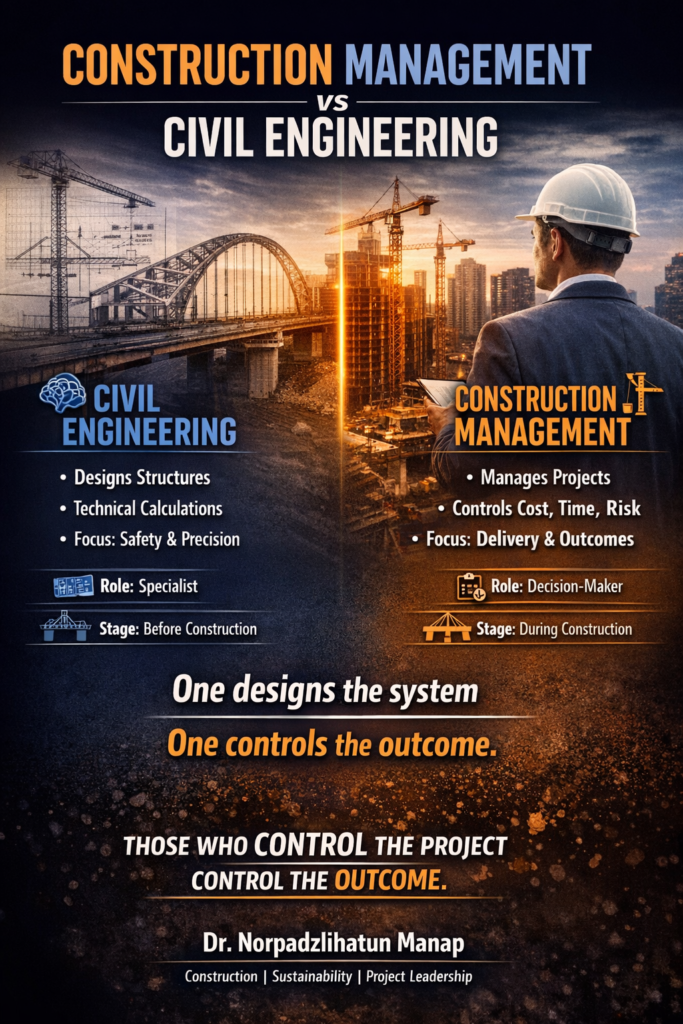
🏗️ Construction Management vs Civil Engineering

Two paths, two types of power in the construction industry


🧭 Big Picture

Both fields operate within the same ecosystem—
but they play fundamentally different roles:

  • Civil Engineering → Designs and ensures structural safety
  • Construction Management → Ensures the project actually happens—and succeeds

👉 One creates the technical foundation
👉 The other determines the final outcome


⚙️ Core Differences

1. 🧠 Core Focus

Civil Engineering

  • Structural design (roads, bridges, buildings)
  • Technical analysis (loads, stresses, materials)
  • Calculations and modelling

Construction Management

  • Project planning
  • Cost and time control
  • Contract and risk management
  • Coordination of all stakeholders

👉 Engineers ask: “Is this structure safe?”
👉 Managers ask: “Can this be delivered on time, within budget, and at the right quality?”


2. 📍 Position in the Project Lifecycle

Civil Engineering

  • Dominant in the design and early analysis stage
  • Heavily involved before construction begins

Construction Management

  • Dominant in the execution phase (construction stage)
  • Involved from initiation to project completion

👉 Engineers create the plan
👉 Managers make the plan a reality


3. 🧩 Skill Sets

Civil Engineering

  • Strong mathematics and physics
  • Deep technical analysis
  • Precision in calculations

Construction Management

  • Leadership and communication
  • Conflict management
  • Fast decision-making in real-world situations

👉 One focuses on technical precision
👉 The other on decision-making under complexity


4. 📊 Risk & Responsibility

Civil Engineering

  • Risk of structural failure
  • Public safety
  • Professional liability (design responsibility)

Construction Management

  • Financial risks
  • Project delays
  • Contract disputes

👉 Engineers carry technical risk
👉 Managers carry strategic and financial risk


5. 🚀 Career Path & Power

Civil Engineering

  • Design engineer
  • Consultant
  • Technical specialist

Construction Management

  • Project manager
  • Project director
  • Organizational leader

👉 In the long run:

  • Engineers = specialists
  • Managers = decision-makers

🔥 Industry Reality (Rarely Discussed)

Many professionals start as engineers.

But to reach the highest levels in the industry:

👉 They transition into Construction Management

Because:

  • Projects rarely fail due to calculations alone
  • Projects fail due to poor management

🇲🇾 Malaysian Context

In the local market:

  • Civil engineering graduates → abundant
  • Individuals who can truly manage large-scale projects → limited

👉 This creates a strategic advantage for those in Construction Management


🎯 So, Which Is Better?

This is the wrong question.

The real question is:

Who do you want to be in a project?

  • Want to design the system → choose Civil Engineering
  • Want to control the system and outcomes → choose Construction Management

✍️ Conclusion 

Within the power structure of the construction industry:

  • Civil Engineering builds the technical foundation of trust
  • Construction Management determines the actual success of the project

And ultimately—

Those who control the project, control the outcome.


From Research to Policy: How My Dredging Studies Influence International Decision-Making

Introduction

In academia, success is often measured by the number of publications and citations.

However, the true measure of impactful research lies beyond journals—when research begins to inform policies, guide governments, and influence real-world decisions.

As the main author, I am proud to share that two of my research papers in the field of dredging environmental management have reached this level of impact, being cited in international policy documents.

This represents a critical transition:

From academic publication → to global policy influence.


📌 Research Contribution 1

Environmental Management for Dredging Sediments – The requirement of developing nations (2015)

Journal of Environmental Management

This paper provides a comprehensive review of:

  • Environmental impacts of dredging activities
  • Challenges faced by developing nations
  • The need for integrated environmental management frameworks

📊 Impact Indicators

  • 109 citations
  • 262 academic captures (Mendeley readers)
  • Referenced in international policy documents

🌍 Policy Influence

This research has been cited by:

  • United Nations Environment Programme (UNEP)
  • Welsh Government (United Kingdom)

These citations demonstrate that the research contributes to policy-level discussions on environmental governance and marine resource management.


📌 Research Contribution 2

Data Analysis for Environmental Impact of Dredging (2016)

Journal of Cleaner Production

This study focuses on:

  • Data-driven assessment of environmental impacts
  • Identification of key pollutants (e.g., heavy metals, oxygen demand)
  • Analytical framework for evaluating dredging-related environmental risks

📊 Impact Indicators

  • 60 citations
  • 181 academic captures
  • Referenced in international policy documentation

🌍 Policy Influence

This work has been cited in:

  • Government report by Québec, Canada

This highlights the global applicability of the research, extending its relevance beyond Malaysia to international environmental assessment practices.


🔍 Why Policy Impact Matters

Many academic works remain within the boundaries of journals.

However, research that reaches policy level:

  • Influences government decision-making
  • Contributes to regulatory frameworks
  • Impacts environmental sustainability practices globally

This is the highest level of research impact.


🧠 Research Positioning and Expertise

These contributions reinforce my research positioning in:

  • Environmental management of dredging
  • Sustainable infrastructure and marine ecosystems
  • Evidence-based environmental assessment
  • Policy-relevant research for developing and developed nations

This alignment ensures that the research is not only academically rigorous, but also strategically relevant to global challenges.


🎓 Opportunities for PhD Candidates

I am currently open to self-funded PhD (Research Mode) candidates who are interested in:

  • High-impact research beyond publication
  • Policy-relevant environmental studies
  • Dredging, sustainability, and environmental management

If your goal is not just to earn a PhD, but to:

✔ Produce impactful research
✔ Contribute to global policy discussions
✔ Build a strong academic and professional profile

You are encouraged to get in touch.


🚀 Conclusion

The journey from publication to policy impact is not accidental.

It requires:

  • Strong research design
  • Real-world relevance
  • Strategic positioning
  • Consistent academic contribution

These two papers demonstrate that research originating from Malaysia can:

Influence global policies, shape environmental governance, and contribute to sustainable development worldwide.


📩 Contact & Collaboration
🌐 www.drnorpadzlihatun.com


🌍 Dari Malaysia ke Impak Polisi Global: Bagaimana Penyelidikan Saya Mempengaruhi Pembuatan Keputusan di Peringkat Antarabangsa

Pengenalan

Dalam dunia akademik, kejayaan sering diukur melalui bilangan penerbitan dan sitasi.

Namun, impak sebenar penyelidikan adalah apabila ia melangkaui jurnal dan mula mempengaruhi polisi, membimbing kerajaan, serta memberi kesan kepada keputusan dunia sebenar.

Sebagai penulis utama (main author), saya berbangga bahawa dua hasil penyelidikan saya dalam bidang pengurusan alam sekitar berkaitan pengorekan sedimen telah mencapai tahap ini, apabila dirujuk dalam dokumen polisi antarabangsa.

Ini menandakan peralihan penting:

Daripada penerbitan akademik → kepada pengaruh polisi global


📌 Sumbangan Penyelidikan 1

Environmental management for dredging sediments – The requirement of developing nations  (2015)

Journal of Environmental Management

Kajian ini memberi fokus kepada:

  • Impak alam sekitar akibat aktiviti pengorekan sedimen
  • Cabaran yang dihadapi oleh negara membangun
  • Keperluan kepada rangka kerja pengurusan alam sekitar yang bersepadu

📊 Indikator Impak

  • 109 sitasi
  • 262 pembaca akademik (Mendeley)
  • Dirujuk dalam dokumen polisi antarabangsa

🌍 Pengaruh Polisi

Penyelidikan ini telah dirujuk oleh:

  • United Nations Environment Programme (UNEP)
  • Kerajaan Wales, United Kingdom

Ini menunjukkan bahawa kajian ini menyumbang kepada perbincangan dasar dalam pengurusan alam sekitar dan sumber marin di peringkat global.


📌 Sumbangan Penyelidikan 2

Data Analysis for Environmental Impact of Dredging (2016)

Journal of Cleaner Production

Kajian ini menumpukan kepada:

  • Analisis berasaskan data terhadap impak alam sekitar
  • Pengenalpastian bahan pencemar utama (logam berat,’oxygen demand’, dll.)
  • Kerangka analitikal untuk penilaian impak pengorekan sedimen

📊 Indikator Impak

  • 60 sitasi
  • 181 pembaca akademik
  • Dirujuk dalam dokumen polisi antarabangsa

🌍 Pengaruh Polisi

Kajian ini telah dirujuk dalam:

  • Laporan kerajaan Québec, Kanada

Ini membuktikan bahawa penyelidikan ini mempunyai kebolehgunaan global dan relevan dalam konteks antarabangsa.


🔍 Mengapa Impak Polisi Sangat Penting

Tidak semua penyelidikan memberi kesan di luar jurnal akademik.

Namun, penyelidikan yang mencapai tahap polisi:

  • Mempengaruhi keputusan kerajaan
  • Menyumbang kepada pembentukan peraturan dan garis panduan
  • Memberi kesan kepada kelestarian alam sekitar secara global

👉 Inilah tahap impak tertinggi dalam penyelidikan.


🧠 Kedudukan Kepakaran Penyelidikan

Kedua-dua kajian ini memperkukuhkan kedudukan saya dalam bidang:

  • Pengurusan alam sekitar bagi pengorekan sedimen
  • Infrastruktur lestari dan ekosistem marin
  • Penilaian impak berasaskan bukti
  • Penyelidikan yang relevan kepada polisi

Ini memastikan penyelidikan bukan sahaja kukuh dari segi akademik, tetapi juga strategik dalam menangani cabaran global.


🎓 Peluang untuk Calon PhD

Saya membuka peluang kepada pelajar PhD (mod penyelidikan, self-funded) yang berminat dalam:

  • Penyelidikan berimpak tinggi
  • Kajian berkaitan polisi dan alam sekitar
  • Pengorekan sedimen, kelestarian, dan pengurusan alam sekitar

Jika anda ingin:

✔ Menghasilkan penyelidikan yang memberi impak sebenar
✔ Menyumbang kepada polisi global
✔ Membina profil akademik yang kukuh

👉 Anda dialu-alukan untuk berhubung.


🚀 Kesimpulan

Perjalanan daripada penerbitan ke impak polisi bukan sesuatu yang berlaku secara kebetulan.

Ia memerlukan:

  • Reka bentuk penyelidikan yang kukuh
  • Relevansi dunia sebenar
  • Strategi penyelidikan yang jelas
  • Konsistensi dalam penghasilan ilmu

Kedua-dua kajian ini membuktikan bahawa:

Penyelidikan dari Malaysia mampu mempengaruhi polisi global dan menyumbang kepada pembangunan lestari dunia.


📩 Hubungi & Kolaborasi
🌐 www.drnorpadzlihatun.com


Seventy years of construction management research (1954–2026): a global scientometric and bibliometric review of trends, gaps and future directions

Recent Publication: A 70-Year Perspective on Construction Management Research

Seventy years of construction management research (1954–2026): a global scientometric and bibliometric review of trends, gaps and future directions

Step-by-Step Guide to Publish a Q1 Journal Paper


Introduction

Publishing in Q1 journals is often seen as difficult—especially for researchers based in developing countries like Malaysia. Many believe that success depends on connections, luck, or institutional reputation.

The truth is different.

Publishing in Q1 journals is a structured process, not a mystery.

If you understand the system, follow the right steps, and maintain consistency—you can publish in high-impact journals.


📊 Step 1: Identify a Strong Research Problem

Every Q1 paper starts with a clear and meaningful research gap.

Ask yourself:

  • What is missing in current literature?
  • Why does this problem matter?
  • Who benefits from this research?

👉 Avoid:

  • Repeating existing studies
  • Choosing topics without impact

✔ Q1 journals prioritize relevance and contribution


📚 Step 2: Conduct a High-Quality Literature Review

Your literature review should:

  • Cover recent Q1/Q2 journal articles
  • Identify gaps clearly
  • Show deep understanding of the field

Use tools like:

  • Scopus
  • Web of Science
  • VOSviewer

👉 Tip:
Do not just summarize—analyze and connect ideas


🧪 Step 3: Design a Strong Methodology

This is where many papers fail.

Ensure:
✔ Method matches research objective
✔ Data collection is reliable
✔ Analysis is appropriate and justified

👉 Remember:

A weak methodology = immediate rejection


📈 Step 4: Focus on Novelty and Contribution

Reviewers always ask:

“What is new?”

Your paper must:

  • Add new knowledge
  • Offer new insights
  • Improve existing methods

👉 Even small novelty is acceptable—
as long as it is clear and justified


✍️ Step 5: Write Clearly and Strategically

Good writing is critical.

Structure your paper properly:

  • Introduction → Problem & gap
  • Methodology → Clear and justified
  • Results → Objective presentation
  • Discussion → Deep analysis

👉 Avoid:
❌ Long, unclear sentences
❌ Weak arguments
❌ Poor flow


🤖 Step 6: Use ChatGPT (Strategically)

ChatGPT can help with:
✔ Improving language
✔ Structuring paragraphs
✔ Clarifying ideas

But:
❌ It cannot replace research thinking
❌ It cannot generate novelty

👉 Use it as:
A writing assistant—not a research engine


📑 Step 7: Select the Right Journal

This is a critical step.

Check:
✔ Journal scope
✔ Recent publications
✔ Target audience

👉 Common mistake:
Submitting to journals that do not match your topic


📨 Step 8: Handle Reviewer Comments Properly

Most Q1 papers are not accepted on the first submission.

When you receive comments:
✔ Respond professionally
✔ Address every point
✔ Revise carefully

👉 Never:
❌ Ignore reviewer feedback
❌ Respond emotionally


🚀 Step 9: Be Consistent (This Is the Key)

Publishing is not a one-time success.

You need:

  • Multiple submissions
  • Continuous improvement
  • Long-term discipline

👉 Researchers who succeed are not always the smartest—
they are the most consistent


⚠️ Step 10: Build Your Own Research Strength (Not Just Authorship)

This is a critical but often overlooked point in academia.

Publishing in Q1 journals is not about how many papers your name appears on—
it is about how much you truly contribute to the research.

Strong researchers:
✔ Develop their own ideas
✔ Lead their own studies
✔ Understand every part of their research

👉 Not:
❌ Simply attaching their name to papers
❌ Contributing minimally
❌ Depending entirely on others’ work

While “tumpang authorship” may create the appearance of productivity,
it does not build:

  • Research capability
  • Critical thinking
  • Academic credibility

In the long run, true expertise comes from your own effort—not borrowed authorship.


🎓 Special Note for Researchers in Malaysia

You do not need to be in a “top global university” to publish Q1 papers.

What you need:
✔ Strong research fundamentals
✔ Access to journals (Scopus, WoS)
✔ Good supervision
✔ Persistence

👉 Many successful Q1 publications come from Malaysia
because researchers focus on quality and niche expertise


✨ Conclusion

Publishing in Q1 journals is not about luck, connections, or tools.

It is about:

  • Strong research design
  • Clear contribution
  • Consistent effort

And most importantly:

Real academic growth comes from your own work—not just your name on papers.


🔥 Call to Action

If you are interested in pursuing Master or PhD research in Malaysia, particularly in:

  • Sustainable construction
  • Environmental engineering
  • Construction management

Feel free to reach out:
📧 padzliha@uthm.edu.my


Panduan Langkah Demi Langkah untuk Menerbitkan Artikel dalam Jurnal Q1 


Pengenalan

Menerbitkan artikel dalam jurnal Q1 sering dianggap sukar—terutamanya bagi penyelidik di negara membangun seperti Malaysia. Ramai beranggapan kejayaan bergantung kepada rangkaian, nasib, atau reputasi institusi.

Hakikatnya tidak begitu.

Menerbitkan dalam jurnal Q1 adalah satu proses yang tersusun, bukan sesuatu yang misteri.

Jika anda memahami sistem, mengikuti langkah yang betul, dan konsisten—anda mampu menerbitkan dalam jurnal berimpak tinggi.


📊 Langkah 1: Kenal Pasti Masalah Kajian yang Kukuh

Setiap artikel Q1 bermula dengan jurang kajian yang jelas dan bermakna.

Tanya diri anda:

  • Apa yang masih belum diterokai dalam literatur semasa?
  • Mengapa isu ini penting?
  • Siapa yang mendapat manfaat daripada kajian ini?

👉 Elakkan:

  • Mengulang kajian sedia ada
  • Memilih topik tanpa impak

✔ Jurnal Q1 menekankan relevansi dan sumbangan


📚 Langkah 2: Lakukan Sorotan Literatur Berkualiti Tinggi

Sorotan literatur anda perlu:

  • Merangkumi artikel jurnal Q1/Q2 terkini
  • Mengenal pasti jurang kajian dengan jelas
  • Menunjukkan kefahaman mendalam terhadap bidang

Gunakan platform seperti:

  • Scopus
  • Web of Science
  • VOSviewer

👉 Tip:
Jangan sekadar merumus—analisis dan hubungkan idea


🧪 Langkah 3: Reka Metodologi yang Kukuh

Di sinilah banyak artikel gagal.

Pastikan:
✔ Kaedah selari dengan objektif kajian
✔ Data yang dikumpul boleh dipercayai
✔ Analisis sesuai dan mempunyai justifikasi

👉 Ingat:

Metodologi yang lemah = penolakan awal


📈 Langkah 4: Fokus kepada ‘Novelty’ dan Sumbangan

Reviewer akan sentiasa bertanya:

“Apa yang baharu?”

Artikel anda mesti:

  • Menambah pengetahuan baharu
  • Memberi perspektif baharu
  • Memperbaiki pendekatan sedia ada

👉 Walaupun kecil, novelty itu perlu
jelas dan disokong dengan baik


✍️ Langkah 5: Tulis dengan Jelas dan Strategik

Penulisan yang baik sangat penting.

Struktur artikel:

  • Pengenalan → Masalah & jurang
  • Metodologi → Jelas dan berjustifikasi
  • Keputusan → Penyampaian objektif
  • Perbincangan → Analisis mendalam

👉 Elakkan:
❌ Ayat terlalu panjang dan tidak jelas
❌ Hujah yang lemah
❌ Aliran penulisan yang tidak tersusun


🤖 Langkah 6: Gunakan ChatGPT Secara Strategik

ChatGPT boleh membantu:
✔ Memperbaiki bahasa
✔ Menyusun perenggan
✔ Menjelaskan idea

Namun:
❌ Tidak boleh menggantikan pemikiran penyelidikan
❌ Tidak boleh menghasilkan novelty sebenar

👉 Gunakan sebagai:
alat bantu penulisan, bukan enjin penyelidikan


📑 Langkah 7: Pilih Jurnal yang Tepat

Ini adalah langkah kritikal.

Semak:
✔ Skop jurnal
✔ Artikel terkini yang diterbitkan
✔ Sasaran pembaca

👉 Kesilapan biasa:
Menghantar artikel ke jurnal yang tidak sesuai dengan topik


📨 Langkah 8: Tanggani Komen Reviewer dengan Betul

Kebanyakan artikel Q1 tidak diterima pada penghantaran pertama.

Apabila menerima komen:
✔ Jawab secara profesional
✔ Tanggani setiap isu
✔ Perbaiki dengan teliti

👉 Jangan:
❌ Abaikan komen reviewer
❌ Bertindak secara emosi


🚀 Langkah 9: Konsisten (Ini Kunci Utama)

Penerbitan bukan kejayaan sekali sahaja.

Anda perlu:

  • Menghantar artikel berulang kali
  • Memperbaiki secara berterusan
  • Berdisiplin dalam jangka panjang

👉 Penyelidik berjaya bukan semestinya paling bijak—
tetapi paling konsisten


⚠️ Langkah 10: Bina Kekuatan Penyelidikan Sendiri (Bukan Sekadar Nama)

Ini adalah aspek penting yang sering diabaikan dalam akademia.

Menerbitkan dalam jurnal Q1 bukan tentang berapa banyak artikel yang ada nama anda—
tetapi tentang sejauh mana sumbangan sebenar anda dalam penyelidikan tersebut.

Penyelidik yang kuat:
✔ Menghasilkan idea sendiri
✔ Memimpin kajian sendiri
✔ Memahami setiap aspek penyelidikan

👉 Bukan:
❌ Sekadar meletakkan nama dalam artikel
❌ Menyumbang secara minimum
❌ Bergantung sepenuhnya kepada kerja orang lain

Walaupun “tumpang authorship” mungkin memberi gambaran produktif,
ia tidak membina:

  • Keupayaan penyelidikan
  • Pemikiran kritikal
  • Kredibiliti akademik

Dalam jangka panjang, kepakaran sebenar datang daripada usaha sendiri—bukan pinjaman nama dalam penerbitan.


🎓 Nota Khas untuk Penyelidik di Malaysia

Anda tidak perlu berada di universiti terbaik dunia untuk menerbitkan artikel Q1.

Apa yang diperlukan:
✔ Asas penyelidikan yang kukuh
✔ Akses kepada jurnal (Scopus, WoS)
✔ Penyelia yang baik
✔ Ketekunan

👉 Banyak penerbitan Q1 dari Malaysia berjaya
kerana fokus kepada kualiti dan kepakaran niche


✨ Kesimpulan

Menerbitkan dalam jurnal Q1 bukan tentang nasib, rangkaian, atau alat semata-mata.

Ia tentang:

  • Rekabentuk kajian yang kukuh
  • Sumbangan yang jelas
  • Usaha yang konsisten

Dan yang paling penting:

Pertumbuhan akademik sebenar datang daripada usaha sendiri—bukan sekadar nama dalam penerbitan.


🔥 Call to Action

Jika anda berminat untuk melanjutkan pengajian Master atau PhD di Malaysia, khususnya dalam bidang:

  • Sustainable construction
  • Environmental engineering
  • Construction management

Sila hubungi:
📧 padzliha@uthm.edu.my

Can ChatGPT Really Help You Publish Q1 Papers? The Reality No One Talks About

Introduction

The rise of AI tools like ChatGPT has sparked a major shift in academic research and writing. Many researchers are now asking:

Can ChatGPT actually help you publish in Q1 journals?

The short answer is: Yes—but not in the way most people think.

The real issue is not whether ChatGPT works.
It is whether the researcher has the foundation to use it effectively.


🤖 What ChatGPT Can Actually Help With

ChatGPT can be a powerful assistant in the research process. When used correctly, it can help with:

✔ Generating research ideas
✔ Structuring literature reviews
✔ Improving language and clarity
✔ Summarizing complex concepts
✔ Speeding up writing workflows

👉 In simple terms:
ChatGPT improves efficiency—but not research quality by itself.


❌ What ChatGPT Cannot Do

Despite its capabilities, ChatGPT has clear limitations:

❌ It cannot replace critical thinking
❌ It cannot design a strong research methodology
❌ It cannot generate true novelty
❌ It cannot guarantee publication success

👉 This is where many researchers misunderstand AI.

Using ChatGPT without strong research skills often leads to:

  • Superficial writing
  • Weak arguments
  • Rejected papers

📊 The Truth About Q1 Publications

Publishing in Q1 journals is not about writing speed—it is about:

✔ Strong research design
✔ Clear contribution to knowledge
✔ Rigorous methodology
✔ Critical discussion
✔ Alignment with journal scope

These elements cannot be automated.


⚖️ So, Does ChatGPT Help or Not?

The honest answer:

👉 ChatGPT helps strong researchers become faster.
👉 But it exposes weak research even faster.

In other words:

AI does not create quality—it amplifies it.


🚀 How to Use ChatGPT Strategically for Q1 Papers

If you want to use ChatGPT effectively, follow this approach:

1. Build Your Research Foundation First

Before using AI:

  • Define your research gap
  • Develop a solid methodology
  • Understand your field deeply

2. Use ChatGPT as a Writing Assistant

Use it to:

  • Refine sentences
  • Improve flow
  • Clarify arguments

Not to:

  • “Generate the whole paper”

3. Validate Everything

Always:
✔ Cross-check facts
✔ Verify references
✔ Ensure originality


4. Focus on Contribution

Ask yourself:

“What does my paper add that others don’t?”

If you cannot answer this clearly,
ChatGPT will not save your paper.


🎓 Advice for Students and Early Researchers

If you are aiming to publish in Q1 journals:

✔ Master research fundamentals first
✔ Learn how journals evaluate papers
✔ Use AI as a support tool—not a shortcut
✔ Work with supervisors who have real publication track records


✨ Conclusion

ChatGPT is not the problem—and it is not the solution either.

It is simply a tool.

The real difference between accepted and rejected papers remains the same:

  • Depth of thinking
  • Strength of methodology
  • Clarity of contribution

And ultimately:

Substance will always outlast noise.


🔥 

If you are looking for PhD supervision in:

  • Sustainable construction
  • Environmental engineering
  • Construction management

Feel free to reach out via:
📧 padzliha@uthm.edu.my


Pengenalan

Kemunculan teknologi seperti ChatGPT telah mengubah cara penyelidikan dan penulisan akademik dijalankan. Ramai penyelidik mula bertanya:

Bolehkah ChatGPT membantu saya publish dalam jurnal Q1?

Jawapan ringkasnya: Ya—tetapi bukan seperti yang ramai sangka.

Isu sebenar bukan sama ada ChatGPT itu hebat atau tidak, tetapi:
👉 Adakah penyelidik itu sendiri mempunyai asas yang kukuh?


🤖 Apa Yang ChatGPT Boleh Bantu

ChatGPT boleh menjadi alat yang sangat berguna jika digunakan dengan betul. Ia boleh membantu dalam:

✔ Menjana idea kajian
✔ Menyusun literature review
✔ Memperbaiki bahasa dan penulisan
✔ Meringkaskan konsep kompleks
✔ Menjimatkan masa dalam proses penulisan

👉 Ringkasnya:
ChatGPT meningkatkan kecekapan—bukan kualiti penyelidikan secara automatik.


❌ Apa Yang ChatGPT Tidak Boleh Gantikan

Walaupun hebat, ChatGPT ada hadnya:

❌ Tidak boleh menggantikan pemikiran kritikal
❌ Tidak boleh membina metodologi yang kukuh
❌ Tidak boleh menghasilkan novelty sebenar
❌ Tidak boleh menjamin paper diterima

👉 Inilah kesilapan besar ramai penyelidik.

Menggunakan ChatGPT tanpa asas yang kuat akan menyebabkan:

  • Penulisan superficial
  • Hujah lemah
  • Paper ditolak

📊 Realiti Penerbitan Q1

Untuk publish dalam jurnal Q1, perkara utama adalah:

✔ Rekabentuk kajian yang kukuh
✔ Sumbangan jelas kepada ilmu
✔ Metodologi yang tepat
✔ Perbincangan kritikal
✔ Kesesuaian dengan scope jurnal

👉 Semua ini tidak boleh dihasilkan oleh AI semata-mata.


⚖️ Jadi, ChatGPT Membantu atau Tidak?

Jawapan jujur:

👉 ChatGPT membantu penyelidik yang kuat menjadi lebih pantas
👉 Tetapi memperlihatkan kelemahan penyelidik yang lemah dengan lebih cepat

Dengan kata lain:

AI tidak mencipta kualiti—ia hanya menguatkan apa yang sudah ada.


🚀 Cara Guna ChatGPT Secara Strategik untuk Q1 Paper

1. Kukuhkan Asas Penyelidikan Dulu

Sebelum guna AI:

  • Kenal pasti research gap
  • Bina metodologi yang jelas
  • Fahami bidang kajian secara mendalam

2. Gunakan ChatGPT sebagai Pembantu Penulisan

Gunakan untuk:
✔ Perbaiki ayat
✔ Susun idea
✔ Tingkatkan kejelasan

Bukan untuk:
❌ “Tulis seluruh paper”


3. Semak dan Sahkan Semua

Sentiasa:
✔ Semak fakta
✔ Periksa rujukan
✔ Pastikan keaslian


4. Fokus pada Sumbangan Kajian

Tanya diri:

“Apa yang kajian saya tambah kepada ilmu sedia ada?”

Jika jawapan tidak jelas,
ChatGPT tidak akan mampu membantu.


🎓 Nasihat untuk Pelajar & Penyelidik

Jika anda ingin publish dalam jurnal Q1:

✔ Kuasai asas penyelidikan
✔ Fahami bagaimana reviewer menilai paper
✔ Gunakan AI secara strategik
✔ Pilih supervisor yang mempunyai rekod penerbitan sebenar


✨ Kesimpulan

ChatGPT bukan masalah—dan bukan juga penyelesaian.

Ia hanyalah alat.

Perbezaan antara paper diterima atau ditolak masih sama:

  • Kedalaman pemikiran
  • Kekuatan metodologi
  • Kejelasan sumbangan

Dan akhirnya:

Yang berkualiti dan konsisten akan sentiasa mengatasi si kaki bising dan tin kosong.


🔥 

Jika anda berminat untuk melanjutkan pengajian (Master/PhD) dalam bidang:

  • Sustainable construction
  • Environmental engineering
  • Construction management

Hubungi:
📧 padzliha@uthm.edu.my


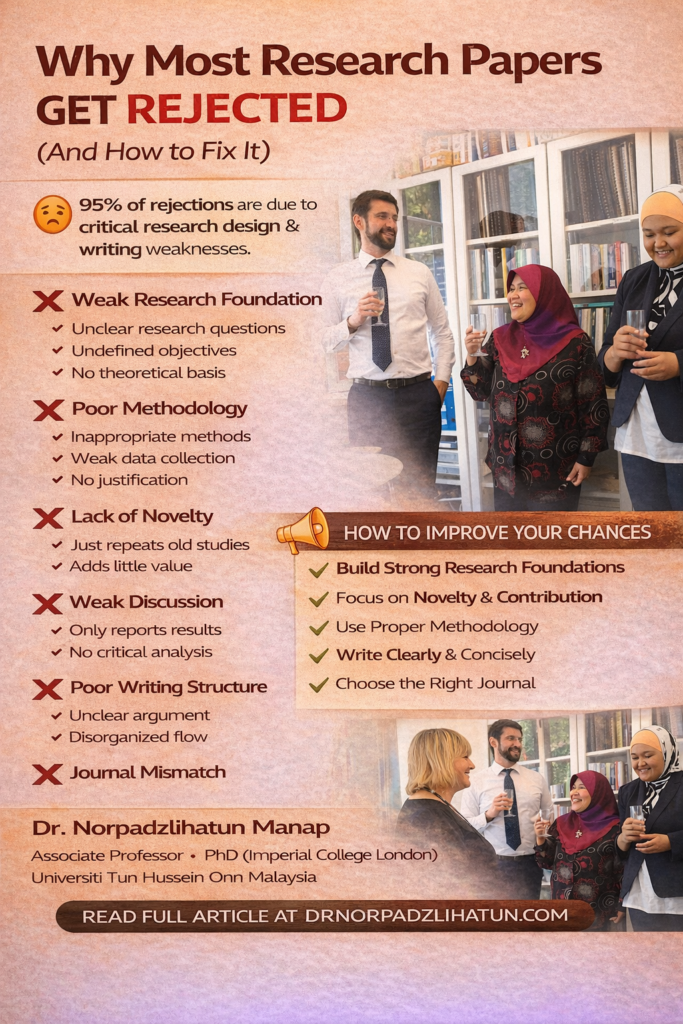
Why Most Research Papers Get Rejected (And How to Fix It)
Introduction

Many researchers believe their papers are rejected because of “bad luck” or “harsh reviewers.”
In reality, most rejections happen due to fundamental weaknesses in research design and writing.

Understanding these reasons is the first step toward publishing in Q1/Q2 journals.


❌ 1. Weak Research Foundation

Many papers fail because:

  • Research questions are unclear
  • Objectives are not well defined
  • No strong theoretical grounding

👉 Journals look for clarity and purpose, not just data.


❌ 2. Poor Methodology

A common issue:

  • Inappropriate methods
  • Weak data collection
  • Lack of justification

👉 Even a “good idea” fails without rigorous methodology.


❌ 3. Lack of Novelty

Reviewers often ask:

“What is new here?”

If your paper:

  • Repeats existing studies
  • Adds little value

➡️ It will likely be rejected.


❌ 4. Weak Discussion & Analysis

Many papers only:

  • Present results
  • But fail to explain “why it matters”

👉 High-impact journals expect:

  • Critical analysis
  • Strong linkage to theory

❌ 5. Poor Writing Structure

Common problems:

  • Unclear flow
  • Weak argument
  • Language issues

👉 A good study can still be rejected due to poor presentation.


❌ 6. Journal Mismatch

Many authors submit to the wrong journal:

  • Scope mismatch
  • Audience mismatch

👉 Always check:
✔ Journal aims & scope
✔ Recent published papers


🚀 How to Improve Your Chances

✔ Build strong research fundamentals
✔ Focus on novelty and contribution
✔ Use proper methodology
✔ Write clearly and professionally
✔ Choose the right journal


✨ Conclusion

Publishing is not about luck.
It is about quality, clarity, and consistency.

Substance will always outlast noise.

*The beverages in our hands in the photo are non-alcoholic

📝 

Kenapa Banyak Paper Ditolak (Dan Cara Betulkan)

Pengenalan

Ramai penyelidik menyangka paper ditolak kerana “nasib” atau reviewer terlalu ketat.
Hakikatnya, kebanyakan penolakan berlaku kerana asas penyelidikan yang lemah.


❌ 1. Asas Kajian Lemah

  • Soalan kajian tidak jelas
  • Objektif kabur
  • Tiada teori kukuh

❌ 2. Metodologi Lemah

  • Kaedah tidak sesuai
  • Data tidak kuat
  • Tiada justifikasi

❌ 3. Tiada Kebaharuan

Kajian hanya ulang:
➡️ Tiada nilai tambah


❌ 4. Perbincangan Lemah

  • Hanya lapor hasil
  • Tiada analisis mendalam

❌ 5. Penulisan Lemah

  • Struktur tidak jelas
  • Idea tidak tersusun

❌ 6. Salah Pilih Jurnal

  • Scope tak sesuai
  • Audience tak kena

🚀 Cara Tingkatkan Peluang

✔ Kukuhkan asas kajian
✔ Fokus novelty
✔ Guna metodologi betul
✔ Tulis dengan jelas
✔ Pilih jurnal tepat


✨ Kesimpulan

Bukan nasib—tetapi kualiti dan konsistensi.

Yang berkualiti dan konsisten akan kekal, manakala si kaki bising serta tin kosong akan hilang


Pensyarah Perlu Tak Guna ChatGPT? Realiti Akademik yang Ramai Tak Berani Cakap

Pensyarah Perlu Tak Guna ChatGPT? Realiti Akademik yang Ramai Tak Berani Cakap

Pengenalan

Sejak kemunculan teknologi seperti ChatGPT, dunia akademik mengalami perubahan yang sangat ketara. Ada yang menerima dengan terbuka, dan ada juga yang menolak tanpa memahami sepenuhnya.

Namun persoalan sebenar bukanlah sama ada kita patut guna AI atau tidak—tetapi siapa yang benar-benar mempunyai asas kukuh dalam penyelidikan.


📊 Pengalaman Sebelum Era ChatGPT

Untuk konteks, saya telah mula menerbitkan artikel dalam jurnal berimpak tinggi (Q1) sejak tahun 2015, iaitu sebelum kewujudan ChatGPT.

Ini menunjukkan bahawa:

  • Keupayaan menghasilkan penyelidikan berkualiti bukan bergantung kepada AI
  • Ia bergantung kepada kefahaman mendalam terhadap metodologi dan bidang kajian
  • Konsistensi adalah kunci kepada kredibiliti akademik

🤖 ChatGPT dalam Akademik: Alat atau Jalan Pintas?

ChatGPT hanyalah alat bantu, sama seperti:

  • SPSS
  • MATLAB
  • VOSviewer

Ia membantu mempercepatkan proses, tetapi:
❌ Tidak boleh menggantikan pemikiran kritikal
❌ Tidak boleh menggantikan pengalaman penyelidikan
❌ Tidak boleh menghasilkan idea asli tanpa input berkualiti

👉 Hakikatnya:
AI hanya menguatkan mereka yang sudah kuat.


⚖️ Isu Sebenar dalam Akademia

Apa yang lebih membimbangkan adalah:

  • Penolakan teknologi tanpa pemahaman
  • Kritikan tanpa rekod penerbitan yang jelas
  • Suara kuat tanpa sumbangan ilmiah yang signifikan

Dalam banyak keadaan, kita dapat lihat bahawa:

Mereka yang paling lantang bercakap tidak semestinya yang paling produktif.


🚀 Kenapa Akademik Perlu Bergerak ke Hadapan

Dunia akademik hari ini sangat kompetitif:

  • Jurnal semakin ketat
  • Standard semakin tinggi
  • Persaingan semakin global

Jika kita tidak berubah:
➡️ Kita akan ketinggalan
➡️ Peluang penerbitan akan berkurang
➡️ Kredibiliti akademik akan terjejas


🎓 Untuk Pelajar & Penyelidik Muda

Jika anda ingin berjaya dalam akademik:
✔ Fokus pada asas (methodology & research design)
✔ Gunakan AI secara strategik
✔ Pilih supervisor yang mempunyai rekod Q1/Q2 sebenar
✔ Elakkan hanya ikut “suara popular” tanpa bukti


✨ Kesimpulan

Dalam akademik:

  • Rekod penerbitan adalah bukti sebenar
  • Konsistensi membina reputasi
  • Teknologi hanyalah alat

Dan akhirnya:

Yang berkualiti akan kekal, yang kaki bising tapi kosong output pula akan hilang


Pensyarah Perlu Tak Guna ChatGPT? Realiti Akademik yang Ramai Tak Berani Cakap

🌍  

Should Academics Use ChatGPT? The Reality No One Talks About

Introduction

The rise of tools like ChatGPT has reshaped academia. While some embrace it, others reject it without fully understanding its role.

But the real question is not whether AI should be used—it is who actually has the foundation to produce quality research.


📊 A Track Record Before AI

For context, I have been publishing in Q1 journals since 2015, long before ChatGPT existed.

This proves that:

  • Research quality is not dependent on AI
  • It is built on strong fundamentals
  • Consistency defines academic credibility

🤖 ChatGPT: Tool or Shortcut?

ChatGPT is simply a tool, just like:

  • SPSS
  • MATLAB
  • VOSviewer

It can assist, but it cannot:
❌ Replace critical thinking
❌ Replace research experience
❌ Generate meaningful insight without expertise

👉 Reality:
AI amplifies those who already have substance.


⚖️ The Real Problem in Academia

The issue is not technology, but:

  • Resistance without understanding
  • Criticism without academic output
  • Loud voices without real contributions

As history often shows:

The loudest voices are not always the most credible.


🚀 Why Academics Must Adapt

Modern academia is highly competitive:

  • Journals are stricter
  • Standards are higher
  • Competition is global

Without adaptation:
➡️ You fall behind
➡️ Your publication chances drop
➡️ Your academic credibility weakens


🎓 Advice for Students & Researchers

If you want to succeed:
✔ Master research fundamentals
✔ Use AI strategically
✔ Choose supervisors with proven Q1/Q2 publications
✔ Don’t follow opinions without evidence


✨ Conclusion

In academia:

  • Publication records speak
  • Consistency builds credibility
  • Technology is only a tool

And ultimately:

Substance will always outlast noise.

Eid Mubarak

🌙 Eid Mubarak: Reflections on Gratitude, Purpose and Growth

Eid is more than just a celebration, it is a moment of reflection, gratitude, and renewed purpose.

As we welcome this blessed occasion, we are reminded of the journey we have gone through- days of patience, discipline, and continuous self-improvement. Eid marks not only the end of Ramadan but also the beginning of a stronger, more focused version of ourselves.

✨ A Time for Gratitude

Eid teaches us to appreciate what we often overlook; health, opportunities, progress, and even challenges that shape our growth.

In academia and research, this sense of gratitude is essential. Every publication, every student guided, and every idea developed contributes to a larger purpose: advancing knowledge and creating meaningful impact.

🤝 Strengthening Professional Connections

Eid is also a time to reconnect with students, collaborators, and the wider academic community.

In the world of research, strong professional relationships are critical. Collaboration, mentorship, and intellectual exchange are the foundations of impactful and high-quality work.

🌱 Moving Forward with Purpose

As we celebrate Eid, it is also a time to reset our intentions:

  • To pursue research with integrity and depth
  • To contribute to sustainable and impactful solutions
  • To guide the next generation of researchers with clarity and purpose

In my work, particularly in sustainable construction and environmental management, this sense of purpose continues to drive meaningful outcomes and long-term contributions.

💜 A Personal Message

May this blessed Eid bring peace, success, and clarity in all that you pursue.

May your efforts be rewarded, your work be impactful, and your journey be meaningful.

Let us move forward stronger, wiser, and more purposeful.

Warm regards,
Assoc. Prof. Dr. Norpadzlihatun Manap

🌙 Salam Aidilfitri: Refleksi Syukur, Tujuan dan Perkembangan

Aidilfitri bukan sekadar satu perayaan, tetapi merupakan ruang untuk kita merenung, mensyukuri dan memperbaharui tujuan dalam kehidupan.

Selepas melalui tempoh Ramadan yang penuh dengan disiplin, kesabaran dan muhasabah diri, Aidilfitri hadir sebagai titik permulaan kepada versi diri yang lebih kuat, lebih fokus dan lebih bermakna.

✨ Waktu untuk Bersyukur

Aidilfitri mengingatkan kita untuk menghargai perkara yang sering terlepas pandang; kesihatan, peluang, pencapaian dan juga cabaran yang membentuk diri kita.

Dalam dunia akademik dan penyelidikan, rasa syukur ini amat penting. Setiap penerbitan, setiap pelajar yang dibimbing, dan setiap idea yang dikembangkan merupakan sebahagian daripada usaha untuk menyumbang kepada ilmu dan memberi impak kepada masyarakat.

🤝 Mengukuhkan Hubungan Profesional

Aidilfitri juga menjadi peluang untuk memperkukuh hubungan dengan pelajar, kolaborator dan komuniti akademik yang lebih luas.

Dalam dunia penyelidikan, hubungan profesional yang kukuh adalah asas kepada kejayaan. Kolaborasi, bimbingan dan perkongsian ilmu memainkan peranan penting dalam menghasilkan penyelidikan yang berkualiti tinggi dan berimpak.

🌱 Melangkah ke Hadapan dengan Tujuan

Aidilfitri adalah masa terbaik untuk menetapkan semula niat dan hala tuju:

  • Meneruskan penyelidikan dengan integriti dan ketelitian
  • Menyumbang kepada pembangunan mampan dan penyelesaian yang relevan
  • Membimbing generasi penyelidik masa hadapan dengan jelas dan berprinsip

Dalam bidang saya khususnya pembinaan lestari dan pengurusan alam sekitar, tujuan ini menjadi pemacu kepada penyelidikan yang memberi kesan jangka panjang.

💜 Ucapan Peribadi

Semoga Aidilfitri ini membawa ketenangan, kejayaan dan ketelusan dalam setiap usaha yang anda lakukan.

Semoga segala usaha diberkati, hasil kerja memberi impak, dan perjalanan anda dipenuhi makna.

Marilah kita melangkah ke hadapan dengan lebih kuat, lebih bijaksana dan lebih berfokus.

Salam hormat,
Prof. Madya Dr. Norpadzlihatun Manap

The difference between lecturers with a high H-index and those with a lower H-index?

The difference between lecturers with a high H-index and those with a lower H-index?

The difference between lecturers with a high H-index
and those with a lower H-index…

…is not just about numbers.

It reflects different academic journeys.


📊 What is H-index?
It represents a balance between:

  • number of publications
  • and citation impact

👉 A higher H-index often indicates wider research influence


🧠 Lecturers with a high H-index:

  • Their work is frequently cited
  • They are often part of active research networks
  • Their research has broader visibility in the field

👉 This often reflects consistency over time


📄 Lecturers with a lower H-index:

  • May be early in their academic career
  • May focus more on teaching or other roles
  • May still be building their research direction

👉 This does not necessarily mean lower quality


⚖️ Important perspective:

H-index is not everything.

It can be influenced by:

  • Career length
  • Research field (some fields attract citations faster)
  • Collaboration networks
  • Authorship patterns

🎯 For students:

Do not rely on H-index alone.


Also consider:
✔ First-author contributions
✔ Research consistency
✔ Ability to supervise and guide


💡 Conclusion:

👉 “H-index reflects impact,
but not the full depth of expertise.”


#PhD #Research #AcademicLife #HigherEducation

The difference between lecturers with a high H-index and those with a lower H-index?

Beza pensyarah dengan H-index tinggi
dan H-index rendah…

…bukan sekadar nombor.

Ia berkait dengan corak perjalanan akademik seseorang.


📊 Apa itu H-index secara ringkas?
Ia menggambarkan keseimbangan antara:

  • jumlah penerbitan
  • dan bilangan sitasi

👉 Lebih tinggi H-index, biasanya lebih luas impak kajian tersebut


🧠 Pensyarah dengan H-index tinggi:

  • Karya sering dirujuk oleh penyelidik lain
  • Terlibat dalam jaringan penyelidikan yang aktif
  • Mempunyai impak yang lebih meluas dalam bidang tertentu

👉 Selalunya menunjukkan konsistensi dalam penyelidikan


📄 Pensyarah dengan H-index lebih rendah:

  • Mungkin berada di peringkat awal kerjaya
  • Atau fokus kepada pengajaran dan bidang lain
  • Atau sedang membina arah penyelidikan sendiri

👉 Tidak semestinya kurang berkualiti


⚖️ Perkara penting yang perlu difahami:

H-index bukan segalanya.

Ia boleh dipengaruhi oleh:

  • Tempoh kerjaya
  • Bidang penyelidikan (ada bidang lebih cepat dapat sitasi)
  • Saiz jaringan kolaborasi
  • Corak penulisan (solo vs kolaboratif)

🎯 Untuk pelajar:

Jangan lihat H-index sahaja.
Lihat juga:
✔ Peranan sebagai first author
✔ Konsistensi bidang kajian
✔ Keupayaan membimbing pelajar


💡 Kesimpulan:

👉 “H-index menunjukkan impak,
tetapi tidak sepenuhnya menggambarkan kedalaman ilmu.”


#AcademicLife #Research #PhD #HigherEducation

Many assume that “more papers = better academic”

Many assume that “more papers = better academic.”

I disagree.

There is a fundamental difference between:
🔹 Writing a Q1/Q2 paper from scratch
vs
🔹 Being listed as a co-author in many papers

When you build a paper from the ground up:

  • You identify the research gap
  • You design the methodology
  • You analyse the data
  • You defend every argument

You are not just publishing.
You are creating knowledge.

However, here is what many students do not realise:

👉 To assess a lecturer’s REAL quality,
do not simply count publications.

Look deeper:
✔ Where was their PhD work published?
✔ Did they produce first-author Q1 papers?
✔ Do they have a clear research identity?

Because a PhD is not about assistance.
It is about intellectual independence.

Yes, supervision exists.
But the thinking must be your own.

When a PhD is heavily driven by others:
👉 The degree may be awarded
👉 But the essence of scholarship may not fully develop

And over time, this becomes evident:

  • in supervision quality
  • in originality of ideas
  • in the ability to lead research

The reality is:

👉 Quantity is visible
👉 Quality is traceable
👉 Authenticity is undeniable

So the real question is not:
“How many papers do you have?”

But:
“What have you truly built?”

#PhD #AcademicIntegrity #Research #HigherEducation #Q1Q2Journal

Ramai orang anggap “lagi banyak paper = lagi hebat seorang pakar akademik”.

Saya kurang setuju.

Ada perbezaan besar antara:
🔹 Menulis paper Q1/Q2 dari kosong
vs
🔹 Hanya menjadi co-author dalam banyak paper

Apabila anda bina paper dari awal:

  • Anda kenal pasti jurang kajian
  • Anda reka metodologi
  • Anda analisis data
  • Anda pertahankan setiap hujah

Anda bukan sekadar publish.
Anda membina ilmu.

Namun, ada satu perkara penting yang ramai pelajar tidak tahu:

👉 Untuk menilai kualiti sebenar seorang pensyarah,
jangan hanya lihat jumlah paper.

Lihat lebih dalam:
✔ Di mana hasil PhD beliau diterbitkan?
✔ Adakah beliau menghasilkan paper Q1 sebagai first author?
✔ Adakah beliau mempunyai arah penyelidikan yang jelas?

Kerana PhD bukan tentang bantuan.
Ia tentang kemandirian intelektual.

Ya, bimbingan itu wujud.
Tetapi pemikiran mesti datang daripada diri sendiri.

Jika sesuatu PhD terlalu bergantung kepada orang lain:
👉 Ijazah mungkin diperoleh
👉 Tetapi jati diri sebagai penyelidik tidak terbina sepenuhnya

Dan lama-kelamaan, perkara ini akan terserlah:

  • dalam kualiti penyeliaan
  • dalam keaslian idea
  • dalam keupayaan memimpin penyelidikan

Hakikatnya:

👉 Kuantiti boleh dilihat
👉 Kualiti boleh dikesan
👉 Keaslian tidak boleh disembunyikan

Jadi soalan sebenar bukan:
“Berapa banyak paper yang anda ada?”

Tetapi:
“Apa yang benar-benar anda bina?”

#PhD #Akademia #Penyelidikan #PendidikanTinggi #Q1Q2Journal

PhD in Sustainable Construction in Malaysia: Fees, Funding & How to Apply (2026 Guide)

🎯 Title:

PhD in Sustainable Construction in Malaysia: Fees, Funding & How to Apply (2026 Guide)


Malaysia is becoming an increasingly popular destination for international students pursuing a PhD in engineering and construction-related fields. With affordable tuition fees, English-medium instruction, and growing research output, Malaysia offers a strong platform for postgraduate studies—especially in sustainable construction.

If you are considering pursuing a PhD in this field, this guide will walk you through everything you need to know.

PhD in Sustainable Construction in Malaysia Fees, Funding & How to Apply (2026 Guide)


🇲🇾 Why Choose Malaysia for Your PhD?

Malaysia offers several advantages:

  • Affordable tuition fees compared to the UK, Australia, or the US
  • English as the medium of instruction in most universities
  • Strong research focus in sustainability and infrastructure
  • Opportunities to publish in high-impact international journals

For students from developing countries, Malaysia provides a high-quality yet cost-effective alternative.


💰 Estimated Cost of PhD in Malaysia

The cost of pursuing a PhD in Malaysia is relatively affordable:

  • Tuition fees: RM15,000 – RM30,000 (total programme)
  • Living cost: RM1,200 – RM2,500 per month

👉 Compared to Western countries, this is significantly lower.


🎓 Funding & Scholarships (Important Reality)

One important point:

👉 Most PhD students in Malaysia are self-funded

However, possible funding sources include:

  • Government scholarships from your home country
  • University-level scholarships (limited and competitive)
  • Research assistant (RA) opportunities (depending on grants)

📌 You are strongly encouraged to secure funding before applying.


🧪 Research Areas in Sustainable Construction

If you are applying in this field, here are strong research areas:

  • Sustainable construction materials (e.g., palm oil fuel ash, rice husk ash)
  • Reuse of dredged sediments in civil engineering
  • Circular economy in construction
  • Environmental management of infrastructure projects
  • Scientometric and bibliometric analysis in construction research

👉 Choosing the right research area increases your chances of acceptance.


📝 How to Apply for a PhD in Malaysia

Step 1: Identify Your Research Area

Be clear about your topic and interest.


Step 2: Find a Suitable Supervisor

  • Search via Google Scholar
  • Visit university websites
  • Check recent publications

Step 3: Contact the Supervisor

Send a short and focused email with:

  • Your background
  • Your research interest
  • CV attached

Step 4: Prepare Your Documents

Typically required:

  • Academic transcripts
  • CV
  • Research proposal
  • English proficiency (IELTS/TOEFL)

Step 5: Submit Application

Apply through the university portal.


⚠️ Common Mistakes to Avoid

  • Applying without contacting a supervisor
  • Sending generic emails
  • Weak or unclear research proposal
  • Not preparing financial support

📩 PhD Opportunity in Sustainable Construction

If you are interested in pursuing a PhD in:

  • Sustainable construction materials
  • Environmental infrastructure
  • Construction management research

You are welcome to contact:

Dr Norpadzlihatun Manap
Associate Professor
Universiti Tun Hussein Onn Malaysia

📧 Email: padzliha@uthm.edu.my


🎯 Tajuk:

PhD Pembinaan Lestari di Malaysia: Yuran, Pembiayaan & Cara Memohon (Panduan 2026)


Malaysia semakin menjadi pilihan pelajar antarabangsa untuk melanjutkan pengajian PhD, khususnya dalam bidang pembinaan lestari.


🇲🇾 Kenapa Malaysia?

  • Yuran lebih rendah
  • Medium Bahasa Inggeris
  • Fokus penyelidikan lestari

💰 Anggaran Kos

  • Yuran: RM15,000 – RM30,000
  • Kos sara hidup: RM1,200 – RM2,500/bulan

🎓 Pembiayaan

👉 Kebanyakan pelajar adalah self-funded

Sumber:

  • Biasiswa negara asal
  • Biasiswa universiti
  • RA

🧪 Bidang Kajian

  • Bahan pembinaan lestari
  • Sedimen korekan
  • Ekonomi kitaran
  • Analisis scientometric

📝 Cara Memohon

  • Pilih topik
  • Cari penyelia
  • Hantar email
  • Sediakan dokumen
  • Mohon

📩 Hubungi Saya

📧 padzliha@uthm.edu.my

How to Find a PhD Supervisor in Sustainable Construction (Malaysia Guide 2026)

🎯 Title:

How to Find a PhD Supervisor in Sustainable Construction (Malaysia Guide 2026)


Finding the right PhD supervisor is one of the most important steps in your academic journey. Many students struggle not because they are not qualified, but because they do not know how to approach the right supervisor effectively.

If you are interested in Sustainable Construction, Environmental Engineering, or Construction Management, this guide will help you navigate the process—especially if you are considering Malaysia as your study destination.

Figure: Step-by-step guide to finding a PhD supervisor in sustainable construction (Malaysia)


🎓 What Do PhD Supervisors Look For?

Before contacting a supervisor, you must understand what they are looking for:

  • Research alignment – Your interests must match their expertise
  • Commitment – PhD requires long-term dedication
  • Publication potential – Ability to produce high-impact research
  • Basic research skills – Writing, analysis, and critical thinking

👉 Many students fail at this stage because they send generic emails without understanding the supervisor’s research.


🔍 Step-by-Step: How to Find a PhD Supervisor

1. Search Using Google Scholar

Look for researchers publishing in your area:

  • Sustainable construction materials
  • Circular economy in construction
  • Environmental management

2. Visit University Websites

Check:

  • Academic profiles
  • Research areas
  • Recent publications

3. Use ResearchGate

This platform helps you:

  • Identify active researchers
  • Understand their current work
  • See collaboration opportunities

✉️ How to Email a PhD Supervisor (Example)

Here is a simple and effective template:

Dear Dr [Name],

I am interested in pursuing a PhD in sustainable construction, particularly in [specific topic]. I have reviewed your work on [mention their paper], and I believe my background in [your field] aligns with your research.

I would like to inquire about potential PhD opportunities under your supervision.

Please find my CV attached.

Thank you for your time and consideration.

👉 Keep it short, relevant, and personalised.


⚠️ Common Mistakes Students Make

Avoid these common errors:

  • Sending the same email to many professors
  • Not reading the supervisor’s publications
  • Writing overly long emails
  • Not stating a clear research interest

🧪 Example Research Areas (Sustainable Construction)

If you are unsure what to propose, here are some strong research directions:

  • Sustainable construction materials (e.g., palm oil fuel ash, rice husk ash)
  • Reuse of dredged sediments in civil engineering
  • Circular economy in construction
  • Environmental management of infrastructure projects
  • Scientometric analysis of construction research

Why Consider Malaysia for Your PhD?

Malaysia offers:

  • Affordable tuition fees
  • English-medium instruction
  • Strong research in sustainable construction
  • Opportunities to publish in international journals

📩 Interested in PhD Supervision?

If your research interests align with sustainable construction and environmental infrastructure, you are welcome to contact:

Dr Norpadzlihatun Manap
Associate Professor
Universiti Tun Hussein Onn Malaysia

📧 Email: padzliha@uthm.edu.my


🎯 Tajuk:

Cara Mencari Penyelia PhD dalam Bidang Pembinaan Lestari (Panduan Malaysia 2026)


Mencari penyelia PhD yang sesuai adalah langkah paling penting dalam perjalanan akademik anda. Ramai pelajar gagal bukan kerana tidak layak, tetapi kerana tidak tahu cara mendekati penyelia dengan betul.

Jika anda berminat dalam bidang pembinaan lestari, kejuruteraan alam sekitar atau pengurusan pembinaan, panduan ini akan membantu anda.


🎓 Apa yang Penyelia Cari?

  • Keserasian bidang kajian
  • Komitmen jangka panjang
  • Potensi penerbitan
  • Kemahiran asas penyelidikan

🔍 Cara Mencari Penyelia

  • Google Scholar
  • Website universiti
  • ResearchGate

✉️ Contoh Email

(ikut versi BI di atas)


⚠️ Kesilapan Biasa

  • Email generic
  • Tidak baca kajian penyelia
  • Tiada fokus kajian

🧪 Cadangan Topik Kajian

  • Bahan pembinaan lestari
  • Penggunaan semula sedimen korekan
  • Ekonomi kitaran dalam pembinaan
  • Analisis scientometric

📩 Hubungi Saya

Jika berminat:

📧 padzliha@uthm.edu.my


PhD in Malaysia

PhD in Malaysia (Self-Funded) – Work with an Active Research Supervisor in Sustainable Construction

🎓 Ready to Start Your PhD Journey?

If you are looking for a PhD opportunity in sustainable construction, environmental engineering, or construction management, this could be the right place to begin.

I am currently accepting self-funded PhD students who are serious about:

  • Publishing in high-impact international journals
  • Building a strong academic or industry research profile
  • Working on real-world sustainability challenges

⚠️ Important: Self-Funded PhD in Malaysia

In Malaysia, most PhD opportunities are self-funded, which means:

  • You will need to cover tuition fees
  • You will need to manage your living expenses
  • You may apply for external scholarships (home country / sponsors)

👉 This is not a limitation—it is a strategic investment if you choose the right supervisor and research direction.


🌏 Why Work With Me?

As a supervisor, my focus is not just completing a thesis, but building your research profile.

🔬 Strong Publication Track Record

Research published in:

  • Science of the Total Environment
  • Journal of Environmental Management
  • Journal of Cleaner Production
  • International Journal of Construction Management

🎯 Clear Research Direction

You will not be “lost” in your PhD journey.
I provide:

  • Structured research planning
  • Clear publication targets
  • Continuous guidance

📈 Focus on High-Impact Output

My supervision approach prioritizes:

  • Q1 / Q2 journal publications
  • Strong research positioning
  • Long-term academic visibility

🔍 Available Research Areas

You may apply if your interest aligns with:

  • Sustainable construction materials
  • Reuse of dredged sediments in civil engineering
  • Circular economy in construction
  • Environmental management of infrastructure projects
  • Construction management research analytics
  • Scientometric and bibliometric analysis
  • Outdoor thermal comfort in built environment

🎯 Who Should Apply?

This opportunity is suitable for candidates who are:

  • Highly motivated and independent
  • Interested in publishing internationally
  • Serious about pursuing an academic or research career
  • Willing to invest in a self-funded postgraduate journey

🚀 What You Will Gain

If you join this research group, you can expect:

  • Guidance towards publishing in high-impact journals
  • Exposure to global research trends
  • Development of advanced research skills
  • A strong foundation for:
    • Academic career
    • Research consultancy
    • Industry leadership roles

✉️ How to Apply

If you are interested, send the following:

  • CV
  • Academic transcripts
  • Brief research interest

📩 Email: padzliha@uthm.edu.my


💬 Final Note

A PhD is not just about getting a title.

It is about:

  • Building expertise
  • Creating impact
  • Positioning yourself globally

👉 If you are serious about your future in research and sustainability, I welcome your application.

Let’s build your research journey together.


*Limited slots available. Only serious candidates will be considered.

How to Find a PhD/Master Supervisor in Sustainable Construction

Choosing the right PhD/Master supervisor is one of the most important decisions for postgraduate students. A good supervisor does not only guide research, but also helps students publish in international journals and build a strong academic career.

For students interested in Sustainable Construction and Environmental Infrastructure, Malaysia is becoming an attractive destination for postgraduate research, particularly in areas related to sustainability, climate resilience, and green construction technologies.

This guide explains how to find a suitable PhD/Master supervisor in this field.


1. Identify Your Research Interest

Before contacting a potential supervisor, it is important to have a clear research direction.

Some emerging research topics in sustainable construction include:

  • Sustainable construction materials
  • Circular economy in construction
  • Reuse of dredged sediments in civil engineering
  • Environmental management of infrastructure projects
  • Construction management analytics
  • Scientometric and bibliometric analysis in construction research
  • Outdoor thermal comfort in built environment

Students who already have a clear research topic are more likely to receive a positive response from potential supervisors.


2. Look for Supervisors with Strong Publication Records

A good indicator of an active researcher is their publication record in international journals.

Students should look for supervisors who publish in reputable journals such as:

  • Science of the Total Environment
  • Journal of Environmental Management
  • Journal of Cleaner Production
  • International Journal of Construction Management

Supervisors who actively publish in these journals can provide strong guidance on academic writing, research design, and journal publication strategies.


3. Check the Research Alignment

It is important that your research interest aligns with the supervisor’s expertise.

For example, research areas related to sustainable construction and environmental infrastructure may include:

  • Sustainable construction materials
  • Environmental engineering in infrastructure
  • Construction management research
  • Circular economy in the built environment
  • Climate-responsive urban design

Working with a supervisor whose expertise closely matches your research topic can significantly improve the success of your PhD.


4. Consider Studying in Malaysia

Malaysia offers several advantages for postgraduate research:

  • Internationally recognised universities
  • Growing research in sustainability and infrastructure
  • Lower tuition and living costs compared to many Western countries
  • Opportunities for international collaboration

Many universities in Malaysia welcome international postgraduate students, particularly in engineering, construction, and environmental research fields.


5. Prepare a Strong Email to the Supervisor

When contacting a potential supervisor, your email should include:

  • A short introduction about yourself
  • Your academic background
  • Your research interest or proposed topic
  • Your CV and academic transcripts

Avoid sending generic emails. Instead, explain why you are interested in the supervisor’s research area.


PhD Supervision in Sustainable Construction

Students who are interested in conducting postgraduate research in Sustainable Construction and Environmental Infrastructure are welcome to contact:

Dr Norpadzlihatun Manap
Associate Professor
Universiti Tun Hussein Onn Malaysia (UTHM)

Research areas include:

  • Sustainable construction materials
  • Reuse of dredged sediments in civil engineering
  • Circular economy in construction
  • Environmental management of infrastructure projects
  • Construction management research analytics
  • Scientometric analysis of construction research
  • Outdoor thermal comfort in built environment

Students will be encouraged to produce high-quality research and publish in international journals.

📧 Email: padzliha@uthm.edu.my
🌐 Website: drnorpadzlihatun.com

Self-funded postgraduate candidates who are passionate about sustainability research are welcome to get in touch.

PhD/Master Opportunity in Sustainable Construction and Environmental Infrastructure

Finding the right PhD/Master supervisor is one of the most important decisions in an academic journey. A good supervisor does not only guide research, but also helps students publish internationally and build a strong academic career.

I am currently welcoming motivated postgraduate students (Master by research and PhD) who are interested in Sustainable Construction and Environmental Infrastructure research.

Students who are passionate about research and willing to pursue self-funded postgraduate studies are highly encouraged to apply.

Research Areas

Prospective students may conduct research in several related areas within the built environment and construction sector, including:

  • Sustainable construction materials
  • Reuse of dredged sediments in civil engineering
  • Circular economy in construction
  • Environmental management of infrastructure projects
  • Construction management research analytics
  • Scientometric and bibliometric analysis of construction research
  • Outdoor thermal comfort in built environment

These topics are aligned with global sustainability challenges and are suitable for publication in international journals.

Publication-Oriented Supervision

Students under my supervision will be encouraged to produce high-quality research outputs and publish in international journals indexed in Web of Science and Scopus.

Some journals where related research has been published include:

  • Science of the Total Environment
  • Journal of Environmental Management
  • Journal of Cleaner Production
  • International Journal of Construction Management

Developing strong publications during postgraduate study is essential for those aiming for academic or research careers.

Suitable Academic Background

Applicants with the following backgrounds are encouraged to apply:

  • Construction Management
  • Civil Engineering
  • Environmental Engineering
  • Built Environment
  • Sustainability Studies

Candidates with related interdisciplinary backgrounds may also be considered.

Funding Information

Due to limited research funding available locally, most postgraduate students are expected to secure their own scholarship or funding source.

Examples include:

  • Government scholarships from the applicant’s home country
  • University or ministry scholarships
  • Industry sponsorship
  • Self-funded postgraduate study

Self-funded candidates who are highly motivated and committed to research publication are welcome.

How to Apply

Interested candidates may contact me directly by email with the following documents:

  • Curriculum Vitae (CV)
  • Academic transcripts
  • Brief research interest or proposed topic

📧 Email: padzliha@uthm.edu.my
🌐 Website: https://drnorpadzlihatun.com

Serious applicants who are interested in contributing to sustainable construction and environmental research are encouraged to get in touch.

Menghubungkan Buku Sedimen Korekan dalam Industri Pembinaan dengan Kursus Mekanik Tanah

Menghubungkan Buku Sedimen Korekan dalam Industri Pembinaan dengan Kursus Mekanik Tanah

Image

Buku Sedimen Korekan dalam Industri Pembinaan membincangkan potensi sedimen korekan sebagai bahan yang boleh dimanfaatkan dalam sektor pembinaan. Walaupun sedimen ini sering dianggap sebagai bahan buangan hasil aktiviti pengorekan sungai dan pelabuhan, sebenarnya ia merupakan satu bentuk tanah semula jadi yang boleh dianalisis dan digunakan semula melalui pendekatan geoteknik yang sesuai.

Sebagai pensyarah yang mengajar kursus Mekanik Tanah, topik sedimen korekan sangat berkait rapat dengan konsep asas yang dipelajari oleh pelajar dalam bidang kejuruteraan geoteknik.

Hubungan dengan Konsep Mekanik Tanah

Dalam kursus Mekanik Tanah, pelajar mempelajari beberapa prinsip asas seperti:

  • pengenalpastian dan klasifikasi tanah
  • taburan saiz butiran tanah
  • had Atterberg dan keplastikan tanah
  • pemadatan tanah
  • hubungan fasa tanah

Semua konsep ini penting untuk menentukan ciri-ciri kejuruteraan sedimen korekan dan menilai sama ada bahan tersebut sesuai untuk digunakan dalam aplikasi pembinaan.

Sebagai contoh, analisis taburan saiz butiran dapat menentukan sama ada sedimen terdiri daripada pasir, kelodak atau tanah liat. Ujian had Atterberg pula membantu memahami sifat keplastikan sedimen, manakala ujian pemadatan Proctor digunakan untuk menentukan ketumpatan maksimum dan kandungan lembapan optimum bagi kegunaan dalam kerja tanah.

Menghubungkan Teori dengan Aplikasi Industri

Melalui pemahaman konsep Mekanik Tanah, pelajar dapat melihat bagaimana teori yang dipelajari di dalam bilik kuliah sebenarnya digunakan dalam situasi sebenar di industri pembinaan.

Sedimen korekan boleh dimanfaatkan dalam beberapa aplikasi seperti:

  • kerja penambakan tanah
  • bahan tambakan dalam projek pembinaan
  • bahan tambahan dalam penghasilan bahan binaan

Pendekatan ini selari dengan usaha industri pembinaan untuk menggalakkan penggunaan bahan yang lebih lestari serta mengurangkan kebergantungan kepada sumber semula jadi yang terhad.

Kepentingan kepada Pelajar

Mengaitkan topik sedimen korekan dengan kursus Mekanik Tanah membantu pelajar:

  • memahami aplikasi sebenar prinsip geoteknik
  • melihat kepentingan ujian tanah dalam projek pembinaan
  • mengenali potensi bahan alternatif dalam pembinaan
  • memahami konsep pembinaan mampan

Pendekatan ini juga menjadikan pembelajaran lebih bermakna kerana pelajar dapat melihat bagaimana ilmu yang dipelajari boleh digunakan untuk menyelesaikan masalah sebenar dalam industri.

Penutup

Buku Sedimen Korekan dalam Industri Pembinaan memberikan satu perspektif penting tentang bagaimana bahan yang sebelum ini dianggap sebagai sisa boleh dimanfaatkan sebagai sumber yang bernilai. Dengan mengaitkan konsep ini kepada kursus Mekanik Tanah, pelajar dapat memahami bahawa asas geoteknik memainkan peranan penting dalam pembangunan infrastruktur yang mampan.


Linking the Book Dredged Sediment in the Construction Industry with the Soil Mechanics Course

Image

The book Dredged Sediment in the Construction Industry discusses the potential of dredged sediment as a resource that can be utilised in construction applications. Although dredged sediments are often regarded as waste materials generated from dredging activities in rivers and ports, they are essentially natural soil materials that can be analysed and reused through proper geotechnical evaluation.

As a lecturer teaching the Soil Mechanics course, the topic of dredged sediment is closely related to the fundamental concepts that students learn in geotechnical engineering.

Relationship with Soil Mechanics Concepts

In the Soil Mechanics course, students learn several fundamental principles, including:

  • soil identification and classification
  • grain size distribution
  • Atterberg limits and soil plasticity
  • soil compaction
  • soil phase relationships

These concepts are essential for determining the engineering properties of dredged sediments and evaluating their suitability for construction applications.

For example, grain size distribution analysis can determine whether the sediment consists primarily of sand, silt, or clay. Atterberg limit tests help assess the plasticity behaviour of the material, while Proctor compaction tests are used to determine the optimum moisture content and maximum dry density required for earthwork applications.

Connecting Theory with Industry Practice

By understanding Soil Mechanics principles, students can see how theoretical knowledge learned in the classroom is applied in real construction and infrastructure projects.

Dredged sediments may be utilised in several applications such as:

  • land reclamation
  • construction fill materials
  • supplementary materials in construction products

This approach supports the construction industry’s effort to promote sustainable material use and reduce reliance on limited natural resources.

Educational Value for Students

Relating dredged sediment to the Soil Mechanics course helps students to:

  • understand the real-world application of geotechnical principles
  • appreciate the importance of soil testing in construction projects
  • explore alternative materials in construction engineering
  • understand the concept of sustainable construction practices

This approach also makes learning more meaningful by demonstrating how engineering knowledge can contribute to solving real environmental and construction challenges.

Conclusion

The book Dredged Sediment in the Construction Industry highlights how materials traditionally considered waste can be transformed into valuable resources. By linking this topic with Soil Mechanics, students can better appreciate the critical role of geotechnical knowledge in supporting sustainable infrastructure development.


Peluang Master dan PhD dalam Pengurusan Pembinaan bersama Dr. Norpadzlihatun Manap


Peluang Master dan PhD dalam Pengurusan Pembinaan di UTHM bersama Dr. Norpadzlihatun Manap

Bidang pengurusan pembinaan dan pembinaan mampan semakin penting dalam menghadapi cabaran pembangunan moden, khususnya berkaitan kelestarian alam sekitar, kecekapan sumber dan inovasi bahan binaan.

Seiring dengan perkembangan ini, saya membuka peluang kepada pelajar yang berminat untuk melanjutkan pengajian Master atau PhD dalam Pengurusan Pembinaan di Universiti Tun Hussein Onn Malaysia (UTHM).

Mengenai Penyelia

Saya ialah Dr. Norpadzlihatun Manap, Profesor Madya di Universiti Tun Hussein Onn Malaysia. Saya memperoleh PhD daripada Imperial College London, salah satu universiti terkemuka dunia dalam bidang kejuruteraan dan teknologi.

Penyelidikan saya memberi tumpuan kepada bidang pengurusan pembinaan, pembinaan mampan, bahan binaan lestari serta pengurusan alam sekitar dalam industri pembinaan.

Hasil penyelidikan ini telah diterbitkan dalam jurnal antarabangsa berimpak tinggi yang diindeks oleh Web of Science dan Scopus, termasuk jurnal Q1 seperti:

  • Science of the Total Environment
  • Journal of Environmental Management
  • Journal of Cleaner Production

Artikel Terbaru dalam International Journal of Construction Management

Artikel terbaru saya telah diterbitkan dalam International Journal of Construction Management, sebuah jurnal antarabangsa yang memberi fokus kepada penyelidikan dalam bidang pengurusan pembinaan.

Artikel ini membincangkan perkembangan dan arah penyelidikan global dalam bidang Construction Management menggunakan pendekatan bibliometrik dan scientometric.

Kajian ini menganalisis trend penyelidikan, pengaruh penyelidik utama serta jurang kajian dalam bidang pengurusan pembinaan bagi membantu membentuk hala tuju penyelidikan masa hadapan dalam disiplin ini.

Artikel penuh boleh diakses melalui pautan berikut:

https://www.tandfonline.com/eprint/HPDTWFX9QZK2IXP2SYU3/full?target=10.1080/15623599.2026.2636729

Bidang Penyelidikan

Pelajar yang berminat boleh menjalankan penyelidikan dalam beberapa bidang berikut:

  • Pengurusan pembinaan
  • Pembinaan hijau dan kelestarian
  • Bahan binaan mampan
  • Ekonomi kitar semula dalam pembinaan
  • Penggunaan sedimen pengerukan dalam bahan binaan
  • Analisis bibliometrik dan trend penyelidikan global

Bidang ini sangat relevan dengan cabaran semasa industri pembinaan, khususnya dalam aspek kelestarian, inovasi bahan binaan dan pengurusan projek yang lebih cekap.

Kelebihan Menjadi Pelajar Saya

Sebagai pelajar penyelidikan di bawah penyeliaan saya, anda akan mendapat:

  • Bimbingan untuk menerbitkan artikel dalam jurnal Q1 antarabangsa
  • Peluang kolaborasi penyelidikan antarabangsa
  • Panduan penulisan artikel untuk jurnal Scopus dan Web of Science
  • Pendedahan kepada topik penyelidikan berimpak tinggi

Matlamat saya adalah untuk membantu pelajar bukan sahaja menamatkan pengajian, tetapi juga membina profil akademik yang kukuh di peringkat antarabangsa.

Siapa Yang Sesuai Memohon

Peluang ini sesuai untuk:

  • Pelajar tahun akhir yang ingin menyambung Master
  • Calon Master Penyelidikan
  • Calon PhD
  • Profesional industri yang ingin meningkatkan kelayakan akademik

Jika anda berminat untuk menjalankan penyelidikan dalam bidang pengurusan pembinaan dan pembinaan mampan, saya amat mengalu-alukan anda untuk menghubungi saya.

Hubungi Saya

Maklumat lanjut boleh diperoleh melalui laman web:

https://drnorpadzlihatun.com


Master and PhD Opportunities in Construction Management at UTHM

The field of construction management and sustainable construction is becoming increasingly important as the construction industry faces growing challenges related to sustainability, environmental management, and efficient resource utilisation.

In line with these developments, I am inviting motivated students to pursue Master’s and PhD research in Construction Management at Universiti Tun Hussein Onn Malaysia (UTHM).

About the Supervisor

I am Dr. Norpadzlihatun Manap, an Associate Professor at Universiti Tun Hussein Onn Malaysia. I obtained my PhD from Imperial College London, one of the world’s leading universities in engineering and technology.

My research focuses on construction management, sustainable construction, environmental management, and innovative construction materials.

My work has been published in high-impact international journals indexed in Web of Science and Scopus, including Q1 journals such as:

  • Science of the Total Environment
  • Journal of Environmental Management
  • Journal of Cleaner Production

Latest Publication in the International Journal of Construction Management

My latest article has recently been published in the International Journal of Construction Management, an international journal that focuses on research related to construction management practices and theory.

The paper examines the global research development in Construction Management using bibliometric and scientometric analysis. The study identifies influential researchers, major research clusters, emerging topics, and research gaps in the field.

This work contributes to understanding the evolution of Construction Management research and provides direction for future studies in the discipline.

The full article can be accessed here:

https://www.tandfonline.com/eprint/HPDTWFX9QZK2IXP2SYU3/full?target=10.1080/15623599.2026.2636729

Research Areas

Prospective students may conduct research in several areas, including:

  • Construction management
  • Sustainable and green construction
  • Sustainable construction materials
  • Circular economy in construction
  • Utilisation of dredged sediments in construction materials
  • Bibliometric analysis and global research trends

These research areas are highly relevant to both academic advancement and industry needs, particularly in the context of sustainable infrastructure development.

Why Join My Research Group

Students under my supervision will benefit from:

  • Guidance in publishing in Q1 international journals
  • Opportunities for international research collaboration
  • Mentorship in preparing manuscripts for Scopus and Web of Science journals
  • Research topics with high academic and industry impact

My goal is to support students in developing strong research capabilities and internationally competitive academic profiles.

Who Should Apply

These opportunities are suitable for:

  • Final-year undergraduate students wishing to pursue Master’s studies
  • Candidates interested in research-based Master’s programmes
  • Prospective PhD candidates
  • Industry professionals who wish to enhance their academic qualifications

Contact

For more information, please visit:

https://drnorpadzlihatun.com

I welcome motivated students who are interested in contributing to research in construction management, sustainability, and innovative construction materials.


10 Mistakes Students Make When Choosing a Final Year Project Topic

10 Kesilapan Pelajar Ketika Memilih Topik Projek Tahun Akhir

Memilih topik Projek Tahun Akhir (Final Year Project – FYP) merupakan salah satu keputusan paling penting dalam perjalanan akademik pelajar. Topik yang baik boleh membantu pelajar menghasilkan kajian yang berkualiti dan relevan kepada industri.

Namun begitu, ramai pelajar melakukan beberapa kesilapan yang boleh menyebabkan projek menjadi sukar atau tidak memberi impak yang baik.

Berikut adalah 10 kesilapan yang sering dilakukan oleh pelajar ketika memilih topik FYP.


1. Memilih Topik yang Terlalu Umum

Topik yang terlalu luas akan menyukarkan pelajar untuk memberi fokus kepada kajian.

Contoh yang terlalu umum:
“Construction Management in Malaysia”

Topik yang lebih baik:
“Adoption of BIM in Construction Project Management in Malaysia”


2. Memilih Topik yang Tidak Menarik Minat

FYP biasanya mengambil masa beberapa bulan untuk disiapkan. Jika pelajar tidak berminat dengan topik tersebut, motivasi untuk menjalankan kajian akan menurun.


3. Mengikut Rakan Tanpa Memahami Topik

Sesetengah pelajar memilih topik hanya kerana rakan mereka memilih topik yang sama atau hampir sama. Ini boleh menyebabkan kesukaran apabila mereka tidak benar-benar memahami bidang tersebut.


4. Memilih Topik yang Terlalu Kompleks

Topik yang terlalu kompleks atau memerlukan teknologi yang sukar diperoleh boleh menyukarkan proses penyelidikan.


5. Tidak Memastikan Ketersediaan Data

Salah satu kesilapan paling biasa ialah memilih topik tanpa memastikan data boleh diperoleh.

Contohnya:

  • data industri
  • soal selidik
  • temubual dengan profesional

6. Tidak Menyemak Kajian Lepas

Kajian literatur sangat penting untuk memastikan topik yang dipilih mempunyai asas akademik yang kukuh.


7. Memilih Topik yang Tidak Berkaitan dengan Trend Industri

Topik yang berkaitan dengan isu semasa seperti:

  • sustainable construction
  • BIM
  • digital construction

lebih berpotensi memberi impak kepada industri.


8. Tidak Berbincang dengan Penyelia

Penyelia mempunyai pengalaman dalam menentukan skop kajian yang sesuai.

Berbincang dengan penyelia boleh membantu:

  • memperbaiki topik
  • mengecilkan skop kajian
  • meningkatkan kualiti penyelidikan

9. Memilih Topik Tanpa Potensi Penerbitan

Sesetengah projek FYP yang baik boleh dikembangkan menjadi artikel jurnal atau kertas persidangan.


10. Memilih Topik Saat Akhir

Memilih topik terlalu lewat akan menyebabkan pelajar mempunyai masa yang terhad untuk menjalankan kajian dengan baik.


Peluang Penyelidikan

Pelajar yang berminat menjalankan Projek Tahun Akhir, Sarjana atau PhD dalam bidang berikut dialu-alukan untuk berbincang mengenai peluang penyelidikan:

  • Sustainable Construction
  • Construction Management
  • BIM dan Digital Construction
  • Environmental Management
  • Infrastructure Development

Hubungi

Dr Norpadzlihatun Manap
Faculty of Technology Management & Business
Universiti Tun Hussein Onn Malaysia

🌐 drnorpadzlihatun.com
📧 padzliha@uthm.edu.my


10 Mistakes Students Make When Choosing a Final Year Project Topic

Choosing a Final Year Project (FYP) topic is one of the most important decisions students make during their academic journey.

A good research topic can lead to meaningful research outcomes and even opportunities for academic publication. However, many students make common mistakes when selecting their project topics.

Here are 10 common mistakes students make when choosing a Final Year Project topic.


1. Choosing a Topic that is Too Broad

A very broad topic makes it difficult to focus the research.

Too broad:
“Construction Management in Malaysia”

Better topic:
“BIM Adoption in Construction Project Management in Malaysia”


2. Choosing a Topic that Does Not Interest You

Final Year Projects usually take several months to complete. Choosing a topic that genuinely interests you helps maintain motivation.


3. Following Friends Without Understanding the Topic

Some students choose topics simply because their friends are working on similar topics. This often leads to difficulties in conducting meaningful research.


4. Choosing an Overly Complex Topic

Topics that require advanced technologies or resources that are difficult to obtain may create unnecessary challenges.


5. Not Checking Data Availability

Students often choose topics without ensuring that relevant data can be obtained.

Possible data sources include:

  • industry data
  • surveys
  • interviews with professionals

6. Not Reviewing Previous Research

A strong literature review is essential to ensure that the research topic has academic foundation and relevance.


7. Choosing Topics that are Not Relevant to Industry Trends

Topics related to current industry trends such as:

  • sustainable construction
  • BIM
  • digital construction

are more valuable for both research and career development.


8. Not Discussing with the Supervisor

Supervisors can help refine the research scope and improve the quality of the project.


9. Choosing a Topic Without Publication Potential

Some Final Year Projects can be developed into journal papers or conference publications.


10. Choosing a Topic at the Last Minute

Selecting a topic too late limits the time available to conduct proper research.


Research Opportunities

Students interested in conducting research in:

  • Sustainable Construction
  • Construction Management
  • BIM and Digital Construction
  • Environmental Management
  • Infrastructure Development

are welcome to contact me to discuss research opportunities.


Contact

Dr Norpadzlihatun Manap
Universiti Tun Hussein Onn Malaysia

🌐 drnorpadzlihatun.com
📧 padzliha@uthm.edu.my


Top 20 Sustainable Construction Research Topics for Final Year Project, Master and PhD Students


20 Topik Penyelidikan Pembinaan Mampan untuk Projek Tahun Akhir, Sarjana dan PhD

Industri pembinaan kini sedang melalui transformasi besar yang dipacu oleh keperluan terhadap kelestarian, teknologi digital dan pengurusan alam sekitar. Oleh itu, penyelidikan dalam bidang pembinaan mampan (sustainable construction) menjadi semakin penting dalam bidang pengurusan pembinaan dan pembangunan infrastruktur.

Bagi pelajar yang sedang merancang Projek Tahun Akhir (FYP), Sarjana atau PhD, pemilihan topik penyelidikan yang sesuai merupakan langkah penting dalam menghasilkan kajian yang berkualiti dan memberi impak kepada industri.

Poster di atas mengetengahkan beberapa bidang penyelidikan yang selari dengan trend penyelidikan global dalam industri pembinaan.


Bahan Pembinaan Mampan

Salah satu bidang penyelidikan yang semakin berkembang ialah penggunaan bahan alternatif dan sisa industri bagi menghasilkan bahan binaan yang lebih mesra alam.

Antara topik penyelidikan yang boleh diterokai termasuk:

  • Penggunaan sisa pertanian seperti Palm Oil Fuel Ash (POFA), Rice Husk Ash (RHA) dan Palm Kernel Shell (PKS) dalam konkrit
  • Pembangunan bahan konkrit rendah karbon untuk iklim tropika
  • Pendekatan ekonomi kitaran dalam bahan pembinaan

Penyelidikan dalam bidang ini boleh membantu mengurangkan kesan karbon dan penggunaan sumber semula jadi dalam industri pembinaan.


Pengurusan Pembinaan dan Pembinaan Digital

Selain bahan binaan, bidang pengurusan pembinaan juga sedang mengalami perubahan dengan kemunculan teknologi digital dan analitik data.

Antara topik yang boleh diterokai ialah:

  • Aplikasi kecerdasan buatan (AI) dalam pengurusan pembinaan
  • Pengurusan risiko dalam projek infrastruktur
  • Transformasi digital dalam organisasi pembinaan

Kajian dalam bidang ini dapat membantu meningkatkan kecekapan pengurusan projek dan produktiviti industri pembinaan.


BIM dan Teknologi Digital

Penggunaan Building Information Modelling (BIM) semakin meluas dalam industri pembinaan moden.

Contoh topik penyelidikan termasuk:

  • Tahap penggunaan BIM dalam industri pembinaan Malaysia
  • Integrasi BIM dan kecerdasan buatan dalam perancangan projek
  • Analisis data dalam pengurusan projek pembinaan

Teknologi ini memainkan peranan penting dalam meningkatkan penyelarasan projek, ketepatan perancangan dan pengurusan maklumat pembinaan.


Alam Sekitar dan Infrastruktur Pesisir

Pembangunan infrastruktur juga perlu mengambil kira aspek kelestarian alam sekitar.

Topik penyelidikan dalam bidang ini termasuk:

  • Penggunaan semula sedimen pengerukan dalam pembinaan
  • Impak alam sekitar aktiviti pengerukan
  • Kelestarian infrastruktur pesisir

Bidang ini sangat penting dalam pembangunan pelabuhan, kawasan pesisir dan projek infrastruktur marin.


Peluang Penyelidikan

Pelajar yang berminat untuk menjalankan penyelidikan dalam bidang berikut dialu-alukan untuk berbincang mengenai peluang penyelidikan:

  • Pengurusan Pembinaan
  • Pembinaan Mampan
  • BIM dan Pembinaan Digital
  • Pengurusan Alam Sekitar
  • Infrastruktur dan pembangunan pesisir

Hubungi

Dr Norpadzlihatun Manap
Fakulti Pengurusan Teknologi dan Perniagaan
Universiti Tun Hussein Onn Malaysia

🌐 drnorpadzlihatun.com
📧 padzliha@uthm.edu.my


Top 20 Sustainable Construction Research Topics for Final Year Project, Master and PhD Students

The construction industry is currently experiencing rapid transformation driven by the need for sustainability, digital technologies and environmental responsibility. As a result, research in sustainable construction has become increasingly important in construction management and infrastructure development.

For students preparing their Final Year Project (FYP), Master or PhD research, selecting the right research topic is essential to producing meaningful and impactful work.

The poster above highlights several research areas that align with current global research trends in construction and infrastructure development.


Sustainable Construction Materials

One of the most active research areas in construction today is the development of environmentally friendly construction materials.

Examples of potential research topics include:

  • Use of agricultural waste such as Palm Oil Fuel Ash (POFA), Rice Husk Ash (RHA) and Palm Kernel Shell (PKS) in concrete
  • Development of low-carbon concrete materials suitable for tropical climates
  • Circular economy approaches in construction materials

Research in this area helps reduce the environmental impact and carbon footprint of the construction industry.


Construction Management and Digital Construction

Construction management research is also evolving due to the adoption of digital technologies and data-driven decision making.

Possible research topics include:

  • Artificial intelligence applications in construction
  • Risk management in infrastructure projects
  • Digital transformation in construction organisations

These topics are highly relevant as the industry moves towards smart and data-driven construction management practices.


BIM and Digital Technologies

Another major research direction is the use of Building Information Modelling (BIM) and other digital technologies.

Possible research topics include:

  • BIM adoption in the Malaysian construction industry
  • Integration of BIM and artificial intelligence in project planning
  • Data analytics in construction project management

These technologies improve project coordination, efficiency and information management.


Environmental and Coastal Infrastructure

Sustainability is also critical in coastal and marine infrastructure development.

Research topics include:

  • Sustainable reuse of dredged sediments in construction
  • Environmental impact of dredging activities
  • Coastal infrastructure sustainability

These areas are particularly important for countries involved in port development and coastal infrastructure projects.


Research Opportunities

Students interested in conducting research in areas such as:

  • Construction Management
  • Sustainable Construction
  • BIM and Digital Construction
  • Environmental Management
  • Infrastructure Development

are welcome to discuss potential research opportunities.


Contact

Dr Norpadzlihatun Manap
Faculty of Technology Management & Business
Universiti Tun Hussein Onn Malaysia

🌐 drnorpadzlihatun.com
📧 padzliha@uthm.edu.my