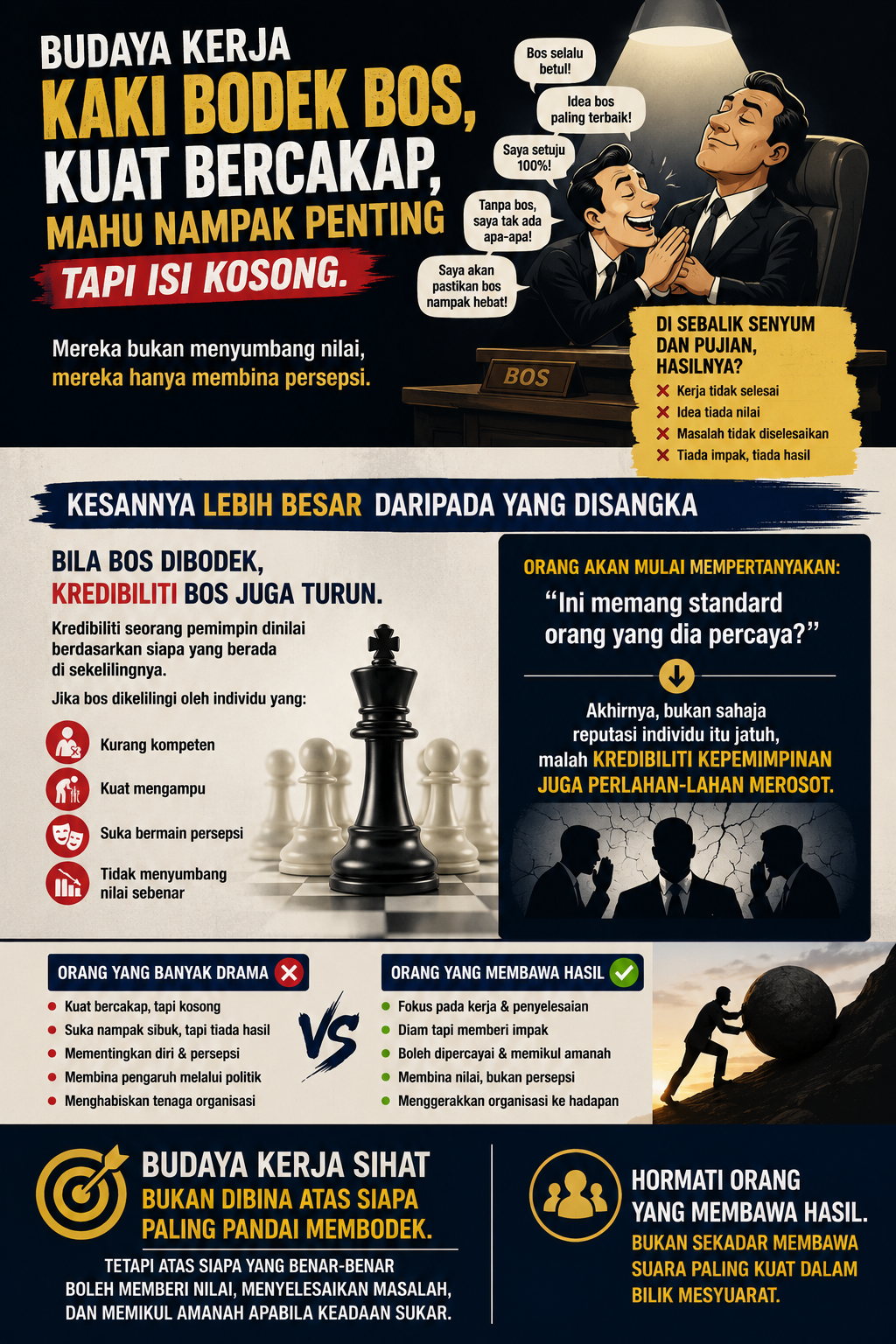
Ramai organisasi hari ini sebenarnya tidak rosak kerana kurang orang pandai bekerja.
Tetapi rosak perlahan-lahan apabila budaya “kaki bodek” mula lebih dihargai daripada budaya kompetensi.
Ada individu yang:
- kuat bercakap,
- suka nampak sibuk,
- mahu dilihat paling rapat dengan bos,
- sentiasa mahu kelihatan penting dalam setiap perkara,
tetapi apabila tiba masa bekerja sebenar — isi kosong, hasil tiada.
Yang lebih bahaya, mereka bukan sahaja menutup kelemahan sendiri dengan bercakap banyak, tetapi cuba membina pengaruh melalui persepsi dan politik dalaman.
Dalam jangka pendek, mungkin mereka nampak “menyerlah”.
Tetapi dalam jangka panjang, organisasi akan mula hilang hormat.
Kenapa?
Kerana kredibiliti seorang pemimpin juga dinilai berdasarkan siapa yang selalu berada di sekelilingnya.
Apabila seseorang bos terlalu banyak dikelilingi oleh individu yang:
- kurang kompeten,
- kuat mengampu,
- suka bermain persepsi,
- dan tidak menyumbang nilai sebenar,
maka orang luar akan mula mempersoalkan:
“Ini memang standard orang yang dia percaya?”
Akhirnya, bukan sahaja reputasi individu itu jatuh — malah kredibiliti kepimpinan juga perlahan-lahan merosot.
Orang yang benar-benar bekerja biasanya tidak banyak drama.
Mereka mungkin pendiam.
Mereka mungkin tidak pandai bermain politik.
Tetapi organisasi sebenarnya bergerak kerana golongan inilah.
Budaya kerja sihat bukan dibina atas siapa paling pandai membodek.
Tetapi atas siapa yang benar-benar boleh memberi nilai, menyelesaikan masalah, dan memikul amanah apabila keadaan sukar.
Hormati orang yang membawa hasil.
Bukan sekadar membawa suara paling kuat dalam bilik mesyuarat.
Some workplaces are not damaged by a lack of intelligent people.
They slowly collapse when the culture of “bootlicking” becomes more rewarded than actual competence.
There are people who:
- talk loudly,
- try hard to look important,
- want to appear close to the boss,
- and constantly create the image that they are “key people” in the organization,
but when real work begins — there is little substance behind the performance.
The dangerous part is this:
instead of contributing real value, they build influence through perception, politics, and excessive self-promotion.
In the short term, these individuals may seem “visible” or “powerful.”
But in the long term, this culture slowly destroys organizational credibility.
Why?
Because a leader is also judged by the people they choose to surround themselves with.
When a boss consistently associates with people who are:
- low in competence,
- high in flattery,
- obsessed with visibility,
- and weak in actual contribution,
people will eventually start questioning the leader’s judgement itself.
“Are these really the people they trust most?”
At that point, the issue is no longer just about the individual.
The leader’s own credibility also begins to decline.
The people who truly carry organizations are often not the loudest in the room.
They may be quiet.
They may dislike politics.
They may not know how to “sell” themselves.
But they are the ones solving problems, carrying responsibilities, and keeping the system functioning when things become difficult.
A healthy work culture should never reward the best actors.
It should reward the people who create real value.
Respect competence.
Not performance without substance.